So does broadcast advertising actually deliver ROI, or is it a nostalgia play?
This guide answers that directly. We'll define what TV and radio advertising is actually called in the industry, break down the real differences between the two, and show how direct-response advertisers turn airtime into trackable revenue.
DX Media Direct has spent 35 years buying broadcast media for clients who need results, not just impressions. Along the way, we've seen which strategies convert browsers into buyers, and which ones just burn budget.
Key Takeaways
- TV and radio fall under "broadcast" advertising, using DRTV and radio spots as core formats.
- TV combines sight, sound, and motion; radio relies on audio alone, shaping cost and production differences.
- Radio wins on speed and cost efficiency; TV wins on reach and production value.
- Negotiated media buying can access rates and inventory that programmatic platforms structurally cannot touch.
What Is TV and Radio Advertising Called? Understanding the Basics
Industry professionals rarely say "TV commercial" or "radio ad" among themselves. The actual terminology looks more like this:
- Spot advertising – the umbrella term for time purchased from an individual TV or radio station
- Spot TV – time bought from individual stations, as opposed to a full network-wide buy
- Radio commercial or "unit" – one commercial message, regardless of its length
- Direct-response TV (DRTV) – television advertising built to generate an immediate viewer response, such as a call or a website visit
- Radio spots – the equivalent commercial unit on radio
A "spot" itself refers to a defined block of paid airtime, typically 15, 30, or 60 seconds, purchased from a network, local station, or radio outlet. That block is the inventory. The commercial is the message that fills it.
Longer formats exist too: ads running 30 minutes or more are called infomercials. The extended airtime gives direct-response advertisers room to build a full case for a new offer, walk through demonstrations, and ask for the sale before time runs out.
Types of TV Advertising Formats
Television inventory splits into a few practical buckets:
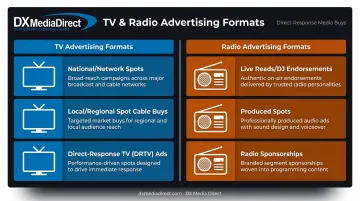
- National/network spots – air across an entire network's affiliate lineup, ideal for brands needing broad, simultaneous exposure
- **Local or regional spot cable buys** – purchased market by market, better suited to businesses testing offers or serving specific geographies
- Direct-response TV (DRTV) ads – identified by trackable phone numbers or promo codes that tie every airing to a measurable response, not just a view
Types of Radio Advertising Formats
Radio offers its own mix of formats:
- Live reads and DJ endorsements – delivered on-air by a radio personality, trading polish for authenticity and trust
- Produced spots – jingles, scripted dialogue, testimonials, or straight reads recorded in advance
- Radio sponsorships – underwriting news, traffic, or sports segments, a subtler format that borrows credibility from surrounding content
Most direct-response campaigns end up blending several of these formats at once, rather than relying on a single approach.
TV vs Radio Advertising: What's the Real Difference?
The gap between TV and radio goes well beyond "one has pictures." Five factors decide which medium actually fits a given campaign.
Cost efficiency. Radio costs less to produce and air than television in most cases. A spot can be scripted, voiced, and airing within days; TV commercials often require casting, a shoot, and post-production. A 15-second radio spot generally costs about half of a 60-second spot, and off-peak dayparts run roughly half the price of drive-time.
Audience targeting. Radio targets through station format. A News/Talk station and a Hip-Hop/R&B station serve entirely different demographics, so choosing the right stations handles much of the targeting before the spot even airs. TV targets more broadly through daypart and program selection.
Engagement and sensory experience. TV combines sight, sound, and motion, making it immersive by default. Radio relies on "theater of the mind," using voice and sound design to make the listener's imagination do the visual work.
Production time and flexibility. A radio script can be revised and back on air the same day if an offer changes. TV's shooting schedule doesn't allow for that kind of last-minute flexibility.
Measurability. Both mediums track results the same way, through unique phone numbers, promo codes, and dedicated landing pages tied to each spot. And despite years of predictions about broadcast's decline, both still reach massive weekly audiences. AM/FM radio reached 87% of U.S. adults weekly, compared to 71% for live and time-shifted TV, according to Nielsen data reported by Radio Ink.
| Factor | TV | Radio |
|---|---|---|
| Production cost | Higher (casting, shoot, edit) | Lower (script, voice, mix) |
| Time to air | Weeks | Days |
| Targeting method | Program/daypart | Station format |
| Sensory input | Sight + sound + motion | Audio only |
| Measurability | Phone numbers, promo codes, landing pages | Phone numbers, promo codes, landing pages |
Neither medium wins outright. The right choice depends on the offer, the timeline, and the budget available.
Why TV and Radio Advertising Still Deliver Real ROI
Plenty of marketers assume broadcast has been quietly dying since streaming took over. The numbers say otherwise. Nielsen's 2025 planning data shows live and time-shifted TV still reaches 68% of Americans age 2 and older every week. Radio's weekly reach runs higher still. This is mass reach most digital channels can't touch at any price.
Reach alone doesn't pay the bills, though. What turns broadcast into a revenue channel, rather than an awareness play, is the direct-response layer built into the spot:
- Unique phone numbers tied to a specific station or airing
- QR codes that route to a tracked landing page
- Promo codes redeemed at checkout
These mechanisms turn "how many people saw this" into "how many people bought this."
Relationship-Based Buying vs. Programmatic Platforms
Programmatic and self-service portals buy inventory through algorithmic auctions at market rate. That works fine for scale, but it's structurally limited.
An algorithm can't take a call from a network sales rep about unsold Tuesday morning inventory that needs to move by Thursday. A buyer with three and a half decades of relationships can, and that's exactly the gap DX Media Direct operates in.
Decades of pattern recognition across dayparts, networks, and product categories also matter when a campaign underperforms. That experience helps separate two very different problems: a media mix issue, meaning the wrong network, daypart, or market, or a creative issue, meaning the wrong message, offer, or call-to-action.
Fixing the wrong problem wastes another testing cycle. Diagnosing the right one turns a break-even test into a scalable campaign.
Frequency Still Builds Recall
Repetition matters, but there's no universal magic number of exposures. The right repetition level depends on brand familiarity, message complexity, and how novel the message feels to the audience, not a fixed rule like "three exposures." A well-planned broadcast schedule accounts for reach and frequency together, rather than chasing raw impression counts.
How Much Does TV and Radio Advertising Cost?
Broadcast pricing varies wildly, for good reason.
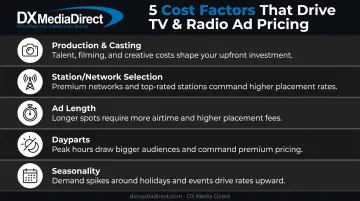
Main cost factors:
- Production and casting – a radio read costs far less to produce than a TV spot with actors, a location shoot, and editing
- Station or network selection – premium programming commands premium rates
- Ad length – a 15-second spot typically costs about half of a 60-second spot
- Dayparts – drive-time radio and primetime TV cost more than overnight or off-peak slots
- Seasonality – demand spikes around major sporting events and holiday seasons push rates up
The spread can be extreme. Ad Age's 2024-25 primetime data shows 30-second national TV spots ranging from $5,081 to over $1 million, depending on the program and audience demand.
That price swing often comes down to strategy as much as popularity. Reach vs. frequency determines how you spend it. More stations and markets buy reach. Concentrating spend on fewer stations with more airings buys frequency. Broad awareness leans toward reach; direct-response offers usually need frequency to close the sale.
That strategic choice affects cost, but so does who negotiates the buy for you. Why a buying partner matters. Rate cards are starting points, not final prices. Remnant inventory, meaning unsold airtime that networks need to move before it expires, can sell for 75% to 90% below rate card.
This is core to how DX Media Direct approaches TV buys: a $500,000 budget negotiated well can buy the equivalent of $2 million to $5 million in rate-card airtime. That gap is the difference between a campaign that breaks even and one that returns 4:1.
Common Mistakes Businesses Make with TV and Radio Campaigns
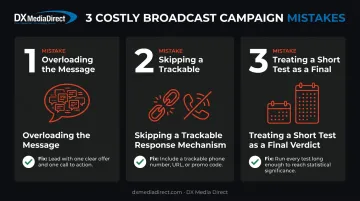
Most broadcast campaigns that "don't work" fail for three predictable reasons.
Overloading the message. Trying to pack three offers, five benefits, and a brand tagline into one 30-second spot leaves viewers remembering nothing. One clear message beats a crowded script every time.
Skipping a trackable response mechanism. A spot without a unique phone number, promo code, or dedicated landing page can't prove it generated revenue. Without that layer, you're measuring guesses.
Treating a short test as a final verdict. A two-week radio buy rarely produces meaningful data. A structured 90-day test, run across enough stations and dayparts, produces a playbook of what actually converts. One education-sector client tracked results by outlet across the full 90-day window and saw a 35% enrollment increase — an insight a two-week test would never have surfaced.
Skipping any one of these doesn't just risk a wasted budget. It risks writing off a channel that, structured correctly, could have been the most profitable one in the mix.
Frequently Asked Questions
What is TV and radio advertising called?
In the industry, it's called broadcast or spot advertising. Television-specific direct-response campaigns are known as direct-response TV (DRTV), while radio commercials are simply called radio spots.
What is the difference between TV and radio advertising?
TV combines sight, sound, and motion, while radio relies purely on audio and imagination. TV generally costs more to produce and targets more broadly, while radio is cheaper, faster, and more targeted through station format.
Which is more cost-effective, TV or radio advertising?
Radio is typically cheaper to produce and air, making it efficient for frequency-driven campaigns. TV can offer a better cost-per-reach for broad awareness goals, depending on the program and audience size.
Can small businesses realistically use TV and radio advertising?
Yes. Local spot buys, targeted dayparts, and remnant inventory make both mediums accessible on modest budgets. An experienced media buying partner can stretch a smaller budget far beyond what rate-card pricing suggests.
How is ROI measured for TV and radio advertising campaigns?
Unique phone numbers, promo codes, and landing page URLs are assigned to each spot. This lets advertisers trace calls, leads, and sales to the exact station and airtime that generated them.
Is traditional broadcast advertising still effective in a digital-first world?
Yes. TV still reaches 68% of Americans weekly, and radio's weekly reach runs even higher. Both channels complement digital advertising rather than compete with it, adding scale most digital platforms can't replicate.