As of 2026, there are 128,787 plumbing businesses operating in the US, all competing for the same searches, the same neighborhoods, and often the same emergency calls at 2 a.m.
Most plumbing owners lean entirely on word-of-mouth. It works, until it doesn't. Referrals alone rarely fill a growing crew's schedule, and they cap how fast you can scale. The shops that break past that ceiling combine digital fundamentals with paid lead generation, retention systems, and yes, traditional advertising once they've outgrown hyperlocal tactics.
This guide covers the digital basics, the paid channels that generate leads fast, an overlooked scale lever, how to keep customers coming back, and exactly how much to budget.
Key Takeaways
- Google Business Profile completeness and review velocity are the top free marketing lever for plumbers
- Layering SEO, paid search, social, and broadcast ads outperforms single-channel reliance
- Digital tactics hit a hyperlocal ceiling; broader reach needs channels like direct-response TV
- Marketing budgets should scale as a percentage of revenue, not a flat number
- Referral and retention systems reduce long-term dependence on paid acquisition
Building Your Digital Marketing Foundation
Before spending a dollar on ads, get your organic presence in order. This is where most plumbing companies leave the easiest wins on the table, and it's foundational work DX Media Direct builds into every SEO engagement because paid campaigns convert better once it's done.
Optimize Your Google Business Profile
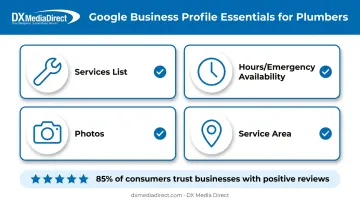
Your Google Business Profile (GBP) is often the first thing a homeowner sees before they see your website. Complete every field:
- Services offered — list each service (drain cleaning, water heater repair, repiping) individually, not just "plumbing"
- Hours, including emergency/24-hour availability if applicable
- Photos of trucks, technicians, and completed jobs
- Service area mapped accurately to avoid showing up for zip codes you don't cover
Profile completeness and review volume are two of the strongest signals Google uses to rank the Local Pack. A thin profile with three reviews will lose to a competitor with fifty, even if your work is better.
Reviews aren't optional anymore. 85% of consumers are more likely to use a business after reading positive reviews, according to BrightLocal's Local Consumer Review Survey.
Build a simple system: text or email every customer within an hour of job completion with a direct review link. Don't wait for happy customers to remember on their own. Most won't.
Strengthen Local SEO and Website Performance
Your website needs to speak the language homeowners actually search. Weave location and service into page titles and headers naturally:
- "Emergency Water Heater Repair in [City]"
- "Trenchless Sewer Line Repair — [City] Plumbers"
- Blog content answering real questions: "Why Is My Water Bill So High?" or "How Often Should I Flush My Water Heater?"
Mobile matters more than most owners realize. A large share of local plumbing searches now happen on a phone, often from someone standing in a flooding bathroom.
If your site loads slowly or the "Call Now" button isn't thumb-friendly, you lose that job to the next listing. Site speed and mobile design directly affect both ranking and conversion.
Claim Directory Listings and Manage Your Reputation
Consistency across directories, meaning your business name, address, and phone number match exactly on Yelp, Angi, Google, and Facebook, tells search engines your business is legitimate. Mismatched listings (different phone numbers, old addresses) confuse both algorithms and customers.
Respond to every review, positive or negative, within a day or two. A thoughtful reply to a one-star review often matters more to a prospective customer than the review itself. It shows how you handle problems, which is exactly what someone hiring a plumber wants to know.
Paid Advertising Channels to Generate Plumbing Leads Fast
Organic presence builds trust over months. Paid channels get you leads this week. Most growing plumbing companies need both running simultaneously.
Google Ads, Local Services Ads and Social Advertising
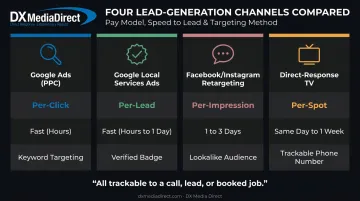
Pay-per-click campaigns targeting high-intent, geo-specific keywords like "emergency plumber [city]" or "24 hour plumber near me" catch customers who are ready to book right now, not researching for later. Use call extensions and call tracking on every campaign so you know which keywords actually turn into paying jobs.
Google Local Services Ads (LSA) work differently. They're pay-per-lead, meaning you only pay when someone actually calls or messages you. To qualify, you'll need the Google Verified badge, which now consolidates the older Guarantee and Screened programs and typically requires proof of licensing and insurance.
For owners who want to stop paying for clicks that never turn into a phone call, LSA is often the better first step.
Facebook and Instagram retargeting fills a different gap. Someone visits your site after a water heater search, doesn't call, and forgets about it. Retargeting ads bring your brand back in front of them, while lookalike audiences help you find new homeowners who resemble your best existing customers.
Direct-Response TV Advertising: The Growth Channel Most Plumbers Overlook
Here's what happens to most plumbing companies as they grow: they max out their hyperlocal digital reach. Google Ads spend plateaus, LSA leads flatten, and the service area they're already dominating on search simply can't produce more volume.
Growth stalls because digital-only strategies have a geographic and volume ceiling, regardless of how well the business is run.
This is where direct-response TV enters the picture, and it's a channel most plumbing owners rule out too early, usually because they assume it's a national-brand budget item. It isn't.
Modern direct-response TV isn't the vague brand-awareness advertising you're picturing. It runs on the same mechanics as your digital campaigns:
- A unique, trackable phone number per spot or network
- A dedicated landing page URL
- A clear call to action tied to a specific offer
Every dollar ties back to a call, a lead, or a booked job, the same way a Google Ads click does.
The barrier that's kept most local service businesses out of TV has historically been cost. That's where a media-buying partner with real network relationships changes the math.
DX Media Direct has spent 35 years buying direct-response media, gaining access to unsold, remnant TV inventory at rates self-serve and programmatic platforms structurally can't reach.
That inventory runs on the same networks, in the same dayparts, at a fraction of rate-card pricing, because an experienced buyer negotiates directly with a network sales rep instead of relying on programmatic algorithms.
The practical move: run a structured 90-day TV test with a defined budget, rather than a small, inconclusive digital-style experiment. Ninety days of real data lets you:
- Read the actual signal instead of guessing from two weeks of noisy numbers
- Refine your offer and creative based on real response patterns
- Build a repeatable playbook you can scale with confidence
Turning First-Time Customers into Repeat Business
Winning a customer once is only half the job. Plumbing has natural repeat-service potential (water heaters age, pipes wear, drains clog again) but only if you stay top-of-mind between emergencies.
Referral programs with real teeth turn happy customers into an unpaid sales team. A $25-$50 credit or discount for both the referrer and the new customer, tracked through a unique code or link, keeps the mechanism simple, since complicated referral rules kill participation.
Automated follow-ups keep your name in front of customers long after the invoice is paid. Post-job email or SMS sequences can cover maintenance reminders and seasonal tips, such as reminding customers to winterize pipes before the first freeze, alongside a simple thank-you message. That ongoing contact sets up the next retention play: recurring revenue.
Maintenance plans turn occasional repairs into predictable income. A membership covering annual inspections, drain treatments, or water heater flushes does three things at once:
- Creates predictable, recurring revenue instead of relying on emergencies
- Reduces churn, since members call you first when something goes wrong
- Opens the door to upsell additional services during routine visits
Retention systems like these lower your dependence on paid acquisition over time. Every repeat customer is a job you didn't have to buy through an ad.
Branding, Reputation and Community Presence
Plumbing is what marketers call an "unsought" service. Nobody thinks about their plumber until something breaks, which means brand recall at that exact moment matters enormously.
- Branded truck wraps and uniforms turn every job site and drive across town into a mobile billboard, building trust before a customer ever calls.
- Referral pipelines with real estate agents and property managers create a steady stream of work. Agents need a trusted plumber for inspections, and property managers keep one on call for emergencies. Both refer repeatedly once they trust you.
- Community involvement, such as sponsoring a little league team or staying active on local platforms, builds the long-term recall that pays off when a pipe bursts and someone remembers your name.
None of these produce next-week leads. They compound over years, which is exactly why the plumbers who've been around longest tend to dominate word-of-mouth in their area.
How Much Should a Plumbing Company Spend on Marketing?
There's no flat dollar figure that works for every plumbing company. What consistently comes up across industry benchmarks is a percentage of revenue.
Residential plumbing and HVAC contractors typically invest 8% to 12% of annual revenue in marketing for active growth, with that range climbing to 12-15% in highly competitive metro markets. A 5% budget is generally considered maintenance-level, enough to keep the phone ringing, not enough to meaningfully grow.
Budget allocation should shift with business stage:
| Stage | Primary Focus | Typical Allocation |
|---|---|---|
| New/growing | Brand-building, lead generation | Front-loaded, higher spend |
| Established | Retention, reputation, referrals | Rebalanced toward existing customers |
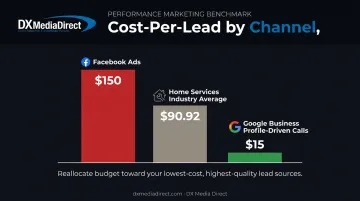
With that stage-based split in place, track cost-per-lead (CPL) and cost-per-acquisition by channel, not just total spend. Home services CPL currently averages around $90.92 according to LocalIQ's search advertising benchmarks. If your Facebook ads are costing $150 per lead while your Google Business Profile (GBP)-driven calls cost $15, that's your reallocation signal, right there in the numbers.
When testing a new channel, especially one like direct-response TV, set a defined budget and timeframe upfront rather than an open-ended commitment.
A free, no-obligation consultation with an experienced media-buying partner can help you forecast realistic ROI before you commit a larger budget. That way, the test itself doesn't become the risk.
Frequently Asked Questions
How do I market my plumbing company?
Combine a strong Google Business Profile with local SEO, paid search or social ads, and a referral system. Once you've maxed out hyperlocal digital reach, direct-response channels like TV help you scale further.
How much should a plumbing company spend on marketing?
Most experts recommend 8-12% of annual revenue for active growth, higher in competitive markets. Track ROI by channel and adjust spend toward whatever's producing the cheapest, best-quality leads.
What is the fastest way to get plumbing leads?
Google Local Services Ads, PPC targeting emergency keywords, and a fully optimized Google Business Profile are the three quickest levers. All three can start generating calls within days of launch.
Do Google Ads work for plumbers?
Yes, especially for high-intent searches like "emergency plumber near me." Geo-targeting and call tracking are essential to confirm the clicks you're paying for actually turn into booked jobs.
Is TV advertising still effective for a local service business like plumbing?
Modern direct-response TV is fully trackable through unique phone numbers and dedicated URLs, unlike old-style brand advertising. It's most effective once a plumbing business has already saturated its local digital reach.
How do I track ROI from my plumbing marketing campaigns?
Use call tracking software with a unique number per channel, dedicated landing pages for each campaign, and tie every booked job back to the source that generated it. Without this, you're guessing.