Here's the real problem, though. Many business owners treat "mass media" and "advertising" as interchangeable terms. They're not, and that confusion leads directly to wasted ad spend and poor media-buying decisions.
This article breaks down how advertising and mass media actually relate, the four major media categories available to you, how professional campaigns get planned, and how to measure whether any of it actually made money.
Key Takeaways
- Advertising is a paid, persuasive message; mass media is just the channel that carries it
- The four core advertising media categories are broadcast, print, outdoor/display, and digital
- Strong campaigns are built on reach, frequency, and continuity, not creative alone
- Relationship-based media buying secures rates and inventory access automated platforms miss
Is Advertising a Form of Mass Media? Understanding the Relationship
No. Advertising and mass media are two different things that happen to work hand-in-hand.
Mass media refers to any channel built to reach large, diverse audiences at once: television, radio, newspapers, magazines, and the internet. Advertising is a paid, sponsor-identified message that gets distributed through those channels.
The distinction comes down to one word: paid. A news segment about a local business isn't advertising. A 30-second commercial that business bought and controls the messaging for? That's advertising, delivered via the mass media infrastructure.
This relationship isn't new: Pew Research found that advertising generated 69% of identified US domestic news revenue (about $43 billion of $63 billion) in its historical analysis of the news industry. Weekly newspapers alone pulled 76% of their revenue from advertising. Mass media, in large part, exists because advertisers fund it.
Why This Relationship Matters for Modern Marketers
During the broadcast era, "mass audience" meant something simple: three networks, one shared viewing experience—but that's gone.
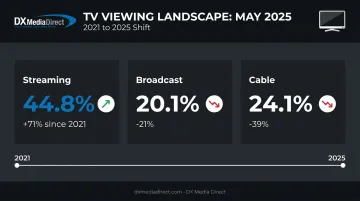
By May 2025, streaming accounted for 44.8% of all TV use in the US, edging out broadcast (20.1%) and cable (24.1%) combined for the first time. Nielsen's data shows streaming use grew 71% since 2021 while broadcast fell 21% and cable dropped 39%.
What does that mean for you? Media selection isn't a single decision anymore. It's dozens of smaller decisions across fragmented platforms, and getting it wrong across all of them compounds the waste.
The 4 Types of Advertising Media Explained
Every advertising channel falls into one of four buckets. Each has a distinct job to do.
Broadcast Media (TV & Radio)
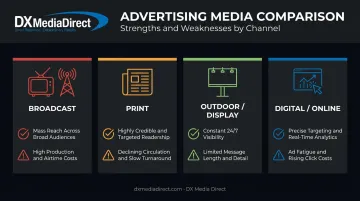
TV and radio still deliver emotional impact and massive reach that few other channels can match. A single national TV spot can reach millions of households in one airing, a scale digital campaigns rarely match.
- Strengths: Sight, sound, and motion create emotional connection; still reaches huge audiences in a single flight
- Weaknesses: High production and placement costs; heavy clutter; impressions fade fast without repetition
Print Media (Newspapers & Magazines)
Print isn't dead, but it's smaller and slower than it used to be.
- Strengths: Strong credibility — Kantar's 2024 Media Reactions study ranked newspapers first among consumers for trust and usefulness
- Weaknesses: Per industry circulation data, combined print/digital daily circulation dropped to 20.9 million in 2022, down 8% year over year; longer lead times for placement
Outdoor/Display Media (Billboards, Transit, Posters)
Out-of-home works through repetition and geography, not depth of message.
- Strengths: Constant repeated exposure; precise geographic targeting; hard to ignore in daily commutes
- Weaknesses: Limited to short, punchy messages; reach is inherently localized
Digital/Online Media (Search, Social, Programmatic, Banner Ads)
Digital dominates spend because it's measurable in ways older media never was. According to industry ad-spend tracking, US internet advertising revenue hit $294.6 billion in 2025, up 13.9% year over year.
- Strengths: Precise audience targeting; real-time performance data
- Weaknesses: Crowded competition drives up costs; ad fatigue sets in fast when targeting gets too aggressive
With all four channels mapped out, the real challenge is choosing which combination fits your business goals.
There's no universal formula here. The right mix depends on your budget, how your specific audience actually consumes media, and what you're selling. A regional home improvement company and a national financial services brand shouldn't be running the same media plan, even with identical budgets.
How Mass Media Advertising Campaigns Are Planned and Executed
Good campaigns aren't improvised. They follow a structure that's existed for decades, whether the medium is a 1980s TV spot or a 2025 CTV buy.
Every ad serves one of three purposes:
- Inform: Introducing a new product or feature (think early smartphone commercials explaining what a touchscreen even does)
- Persuade: Convincing someone your product beats the alternative (competing insurance companies comparing rates)
- Remind: Keeping an established brand top-of-mind (soda commercials that mention nothing new, just the brand)
The Three Pillars of Media Planning
Once that purpose is set, a media plan lives or dies on three variables:
- Reach: How many unique people see the ad at least once
- Frequency: How many times, on average, each person sees it
- Continuity: How that exposure gets timed and scheduled across the campaign
Layered on top of the plan is creative strategy: the message (what you're saying) and the appeal (informational logic vs. emotional pull). Research on rational versus emotional appeals shows neither wins universally. The right choice depends on the product category and context. A life insurance ad leans on logic and statistics; a soda ad leans on nostalgia and feeling.
Scheduling Patterns That Match Business Type
How that plan gets scheduled depends heavily on what you're selling.
- Continuous: Steady advertising year-round, ideal for products bought regularly like groceries or gas
- Flighting: Alternating heavy periods with total silence, suited to seasonal products like tax software or holiday retail
- Pulsing: A steady base level with periodic spikes, matching products with predictable demand peaks like sunscreen during summer
Even a well-matched schedule doesn't guarantee results. When a campaign underperforms, the instinct is to blame the media buy or the creative, rarely both. That's a mistake. Underperformance can come from either side, and diagnosing which one requires looking at both delivery data and message testing before making changes. Agencies with 35 years of campaign history, like DX Media Direct, are built for exactly that kind of diagnosis.
Traditional Mass Media Buying vs. Programmatic/Digital Advertising: What's the Real Difference?
Programmatic advertising automates media buying through algorithm-driven platforms. You set parameters, the system auctions inventory in real time, and placements happen without a human negotiating on your behalf.
Traditional media buying works differently. A buyer negotiates directly with network representatives, building rate and inventory access through relationships that develop over years, not algorithms.
The IAB actually recognizes multiple programmatic deal structures, including negotiated and guaranteed inventory, so it's not accurate to say programmatic can never access premium placements.
There's still a real gap in open-auction efficiency. An ANA study of log-level data from 21 major advertisers found that only 36 cents of every dollar entering a DSP reached the consumer in productive media value in open-web buying specifically.
That inefficiency is exactly where relationship-based buying earns its keep. DX Media Direct has spent 35+ years building direct relationships that predate programmatic advertising entirely. Those relationships translate into concrete advantages:
- Direct negotiation with TV, radio, and streaming network representatives
- Rate and inventory access built on decades of trust, not algorithms
- Remnant inventory available at up to 80% off rate card
Run the math on that:
| Buying Method | Budget | Effective Media Weight |
|---|---|---|
| Standard rate card | $500,000 | $500,000 |
| Remnant buying (80% discount) | $500,000 | $2.5 million equivalent |
No self-serve portal replicates that kind of leverage. It's built on decades of trust between people, not bids in an auction.
Measuring the Success of Mass Media Advertising
Not all metrics are created equal, and this is where a lot of ad spend disappears.
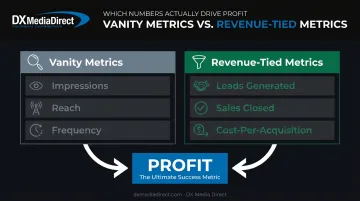
Vanity metrics tell you your ad ran:
- Impressions
- Reach
- Frequency
Revenue-tied metrics tell you whether it worked:
- Leads generated
- Sales closed
- Cost-per-acquisition (CPA)
Tracking these numbers is one thing; proving the ad caused them is another. Marketers use pre-test/post-test methodology to gauge whether a campaign shifted attitudes or behavior, measuring awareness or purchase intent before launch, then again afterward. It's useful, but a before-and-after difference doesn't prove causation on its own. Stronger designs compare an exposed group against a control group to isolate the ad's actual effect.
Here's the part that matters most for most business owners: the only metric that counts is profit. If the advertising generated more than it cost to run, it worked. Everything else is context.
DX Media Direct structures this around a 90-day direct-response TV test — a defined window that generates enough real call, click, and sale data to build a scalable playbook. Instead of guessing from inconclusive impression counts, decisions get made from hard numbers in the profit column. That's the gap between assuming an ad works and proving it does.
Frequently Asked Questions
Is advertising a mass media?
No. Advertising is a paid, sponsor-controlled communication method, while mass media (TV, radio, print, digital) is the delivery infrastructure it travels through. They're related but distinct.
What are the 4 types of advertising media?
The four primary categories are broadcast (TV and radio), print (newspapers and magazines), outdoor/display (billboards and transit ads), and digital/online (search, social, and programmatic).
What is the 3-3-3 rule in marketing?
There's no single, standardized "3-3-3 rule" recognized across the marketing industry. Different agencies define it differently, often to describe breaking campaigns into short, digestible segments, so treat any version you encounter as one firm's framework, not a universal standard.
What is the difference between advertising and mass media?
Mass media refers to the channels, such as TV networks, radio stations, and publishers, that can reach large audiences at once. Advertising is the paid content placed within those channels, often through negotiated media buys, to reach a specific target market.
What is direct-response advertising?
Direct-response advertising is designed to prompt an immediate, trackable action, like a phone call, purchase, or sign-up, rather than simply building brand awareness over time. Every ad includes a specific response mechanism.
How much does mass media advertising typically cost?
Costs vary enormously by medium. National broadcast TV can run over $1 million for a 30-second prime-time spot, while radio and outdoor options are far more affordable. Final rates depend on reach, frequency, and how well they're negotiated.