Clicks pile up. Impressions climb into the millions. Reach numbers look great in a slide deck. None of that tells you if a campaign paid for itself.
Advertising ROI answers the only question that matters: did this campaign generate more profit than it cost to run? Everything else — click-through rate, engagement, follower growth — is secondary until that number is settled.
This guide breaks down what advertising ROI actually means, how to calculate it correctly, what counts as "good," and the specific changes that raise it over time.
Key Takeaways
- Advertising ROI measures net profit as a percentage of ad spend, not clicks or impressions
- The core formula is (Revenue – Ad Cost) / Ad Cost x 100
- There's no universal "good" ROI: it varies by industry, margin, and media channel
- ROI factors in cost and profit margin; ROAS only compares revenue to spend
- Media buying efficiency drives ROI just as much as creative quality does
What Is Advertising ROI?
Advertising ROI is a financial performance metric. It measures how much net profit a specific ad campaign or media channel generated relative to what you spent running it.
That's a narrower question than "Is our marketing working?" Marketing ROI looks at an entire department's output — content, events, PR, social, and ads combined. Advertising ROI isolates one campaign, one channel, or one media buy at a time.
That distinction matters when you're deciding where next quarter's budget goes, because a company might have a healthy overall marketing ROI while one specific ad channel is quietly bleeding money.
The Advertising ROI Formula
The formula itself is simple:
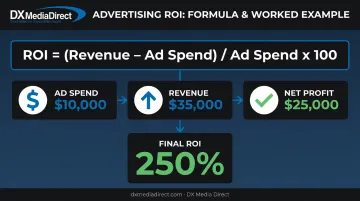
ROI = (Revenue – Ad Spend) / Ad Spend x 100
The tricky part is figuring out what actually belongs in "ad spend." Underestimate it, and your ROI looks better than it really is. True ad spend should include:
- Media buy costs (the actual cost of airtime, impressions, or placements)
- Production costs (filming, editing, voiceover, graphics)
- Agency or management fees
- Any tracking or measurement tools tied to the campaign
Worked example: Say a business invests $10,000 in a TV campaign and generates $35,000 in tracked sales directly attributable to that campaign.
ROI = ($35,000 – $10,000) / $10,000 x 100 = 250%
That's a strong result, but the number only holds up if the $10,000 figure includes production and agency fees, not just the media buy.
Why ROI Is the Metric That Matters Most
Vanity metrics feel good, but they rarely pay the bills. ROI cuts through impressions and clicks by tying advertising directly to the bottom line, which is why direct-response advertisers prioritize it above nearly everything else.
Proving that value to leadership isn't easy, either. In Gartner's 2024 survey of 378 senior marketing leaders, only 52% said they successfully proved marketing's value and received credit for its contribution to business outcomes. CFOs and CEOs were named as the executives most skeptical of marketing's contribution.
That gap is exactly why a clean, defensible ROI number carries so much weight in budget conversations.
What Is a Good ROI for Advertising?
There's no single "good" ROI number that applies across the board. It depends on your industry, your profit margins, the channel you're using, and how mature your business is.
That said, a loose reference point exists. WARC's database of successful ad campaigns found a 4.25:1 cumulative median revenue ROI, up from 3.86:1 five years earlier. Treat that as a directional benchmark from top-performing campaigns, not a target every business should expect to hit immediately.
Direct-response campaigns are held to a different standard than brand-awareness campaigns. Direct-response advertising is built to be immediately profitable, so it's judged on near-term, attributable ROI. Brand-awareness advertising builds long-term equity instead, with payoff that often shows up over quarters or years, not days.
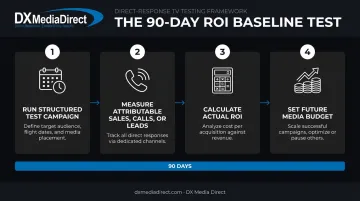
Chasing an industry average can actually mislead you. Your margin structure, average order value, and customer lifetime are unique to your business. A 90-day direct-response TV test is a more reliable way to establish your real baseline ROI before scaling up:
- Run a structured test campaign with a set budget and clear tracking
- Measure attributable sales, calls, or leads over the test window
- Calculate your actual ROI using your real numbers, not industry estimates
- Use that baseline to decide how much media budget makes sense going forward
Once you know your own number, industry benchmarks become far less important.
ROI vs. ROAS and Other Advertising Metrics
ROI and ROAS get used interchangeably. They shouldn't be.
ROAS (Return on Ad Spend) measures revenue against ad spend only. The formula is revenue divided by ad cost, with no adjustment for profit margin, production costs, or overhead. A campaign can post an impressive ROAS and still lose money once real costs are factored in.
Here's how the main performance metrics compare:
| Metric | What it measures | What it misses |
|---|---|---|
| ROAS | Revenue ÷ ad spend | Profit margin, production and fees |
| ROI | Net profit ÷ ad spend | None — it already accounts for real costs |
| CAC | Total spend ÷ new customers acquired | Long-term value of each customer |
| CLV | Total revenue expected from a customer relationship | Immediate campaign profitability |
CAC tells you what each new customer cost, while CLV shows what that customer is worth over time. Both add context, but neither replaces ROI as the profitability check.
Rule of thumb:
- Use ROAS for a quick channel-to-channel comparison.
- Use ROI to confirm whether a campaign actually made you money.
Why Ad ROI Calculations Get Distorted
Even a correct formula can produce a misleading answer if the inputs are flawed. Three problems show up most often.
Attribution challenges. Customers rarely convert after a single touchpoint; they see a TV spot, then a digital ad, then walk into a store, making it genuinely difficult to credit that sale to one channel.
Nielsen's 2025 Annual Marketing Report surveyed 1,400 global marketers and found only 32% measure digital and traditional media spending holistically. Most reporting systems simply aren't built to connect the dots.
The time-lag problem. Brand-building campaigns often show weak near-term ROI, since their real financial payoff builds over months or years, not the first 30 days. Judging a brand campaign on a direct-response timeline will make it look like it's failing when it isn't.
Hidden costs. Forget to include production, talent, or agency fees in your "spend" figure, and your ROI will look better than reality. This is the most common and most avoidable distortion:
- Production costs (often excluded from quick calculations)
- Talent or licensing fees
- Agency management fees
- Software or tracking tool costs tied specifically to the campaign
Fix the inputs before you question the strategy.
How to Improve Your Advertising ROI
Once you've got a clean, honest ROI number, the real work starts. A few levers move that number consistently.
Test constantly. Creative variations, offers, and media placements, and even landing pages should all be in ongoing rotation. ROI rarely improves from one big swing. It improves from dozens of small, measured adjustments over time.
Track offline media properly. TV, radio, and outdoor advertising need dedicated tracking mechanisms, such as unique phone numbers, promo codes, or dedicated landing pages, to solve the attribution problem covered above. Without them, you're guessing at which channel actually drove the sale.
Watch your media buying efficiency. Inefficient buying can erode ROI even when the creative is excellent. Automated programmatic platforms often carry inflated rates and layered fees that never show up in a clean spend report.
This is where relationship-based buying earns its keep. DX Media Direct has spent 35 years building direct-response TV buying relationships across networks, dayparts, and product categories. That accumulated pattern recognition means knowing which dayparts convert for which product types, and which network reps will actually negotiate. It translates into better media rates and scalable playbooks that automated platforms structurally can't replicate.

Diagnose before you change anything. Before adjusting a campaign, figure out whether underperformance comes from the media mix or the creative itself:
- Strong creative on the wrong network or daypart still underperforms
- Great placements running weak creative also underperform
- Fixing the wrong variable wastes budget without moving ROI at all
Getting that diagnosis right is often the difference between a campaign that scales and one that quietly drains the budget.
Frequently Asked Questions
What is ROI in ads?
Advertising ROI measures net profit generated relative to ad spend, expressed as a percentage. The formula is (Revenue – Ad Cost) / Ad Cost × 100.
What is a good ROI for ads?
It varies by industry, profit margins, and channel, so there's no universal number to chase. Establishing your own historical baseline through a test campaign is far more useful than comparing to industry averages.
What's the difference between ROI and ROAS?
ROAS compares revenue to ad spend only, ignoring profit margin and other costs. ROI accounts for those costs, giving you a true picture of profitability rather than just top-line revenue.
How do you calculate advertising ROI manually?
Use (Revenue – Ad Spend) / Ad Spend × 100. Make sure "ad spend" includes media buy costs, production, and agency fees, not just the media placement cost.
Why does my ad ROI look different across channels?
Different channels have different attribution difficulty and payoff timelines. A direct-response digital ad shows near-instant results, while a TV brand campaign may take months to reveal its full impact.
How can a direct-response TV test help determine my true advertising ROI?
DX Media Direct runs structured 90-day test campaigns with clear tracking in place, generating real attributable sales data tied to real spend. That data creates a reliable ROI baseline before you commit to a larger media budget.