Introduction
Streaming services and social feeds get all the marketing attention these days. Meanwhile, AM/FM radio still reaches roughly 90% of U.S. adults every week, according to Nielsen's Total Audience Report, often while they're behind the wheel and headed to their next errand or appointment.
That's not a coincidence dealerships should ignore.
Many dealership marketers write radio off as outdated or too hard to measure. They can't figure out how to budget for it alongside digital spend, and without clear attribution, it feels like a gamble.
This guide breaks down whether radio still works, what it actually costs, which ad formats drive real showroom traffic, and how new technology finally lets you measure results.
Key Takeaways
- Radio reaches most adults weekly, putting your message in front of active car shoppers
- Costs vary by market and daypart, but radio stays cheaper than TV or premium digital
- Standard spots, personality endorsements, and sponsorships each serve a different role in driving traffic
- Connected-car attribution and geo-targeting now let you link radio exposure directly to showroom visits
- An experienced media buyer secures dayparts and rates that self-service platforms simply can't access
Is Radio Advertising Still Effective for Car Dealerships?
The "radio is dying" narrative doesn't hold up against current data. AM/FM radio reaches 87% of U.S. adults 18 and older every week, according to Nielsen audience data cited by the Radio Advertising Bureau. Younger adults aren't opting out either — weekly reach among 18-34 year-olds sits at 79%.
Here's why that matters specifically for dealerships: roughly half of all AM/FM listening among adults 25-54 happens inside a vehicle, according to Edison Research. Even Gen Z, a generation raised on Spotify and TikTok, still spends nearly half of their in-car audio time on traditional AM/FM radios.
That's the advantage TV and social media can't replicate. Your ad plays while someone is literally behind the wheel, thinking about their next vehicle, their commute, or their trade-in.
There's also a behavioral edge over digital formats:
- Fewer than 20% of listeners regularly tune away during radio commercials
- 35% say they rarely or never skip past radio ads
- 46% of consumers say they always avoid online pop-up ads
People are stuck with radio ads in a way they're not with skippable digital formats.
Proving ROI with Modern Attribution & Geo-Targeting Technology
Radio's biggest historical weakness has been measurement. That's changing fast.
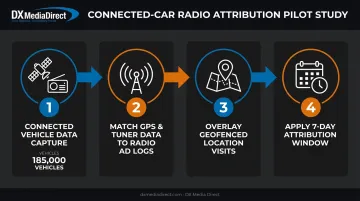
A connected-car pilot involving GM vehicles and Taco Bell tested this directly. Researchers matched 185,000 connected vehicles' GPS and tuner data against radio ad logs and geofenced restaurant visits, using a seven-day attribution window, according to Forbes' coverage of the study.
Standard :30 spots performed strongest individually, while personality reads and news/weather/traffic sponsorships worked best in combination.
Geo-targeting is advancing too. Newer FCC rules now permit program-originating FM boosters to air localized content for up to three minutes per hour, with permanent rules taking effect in July 2025.
Technologies like ZoneCasting let stations serve geographically segmented ads, meaning a dealership could theoretically target listeners specifically within its service radius rather than an entire metro area.
None of this makes radio perfectly trackable overnight. But it's closing the "black box" gap that made dealerships hesitant to commit real budget in the first place.
How Much Does Radio Advertising Cost for Car Dealerships?
Radio pricing isn't one-size-fits-all. Several factors drive the final rate:
- Market size: a top-10 metro costs more than a mid-size market
- Station ratings: higher-rated stations command premium pricing
- Daypart: morning and evening drive command the highest rates
- Spot length: :15s, :30s, and :60s are priced differently
- Frequency: the more spots you run, the better your per-spot rate typically gets
Most stations sell airtime through per-spot rates, bundled packages, or CPM-based buys tied to audience delivery (measured as Average Quarter-Hour and cume). The Radio Advertising Bureau's own modeling shows how weekly volume affects reach:
| Schedule | Spots/Week | Modeled Reach | Avg. Frequency |
|---|---|---|---|
| Very Light | 12 | 34% | 1.4 |
| Light | 25 | 50% | 2.0 |
| Medium | 49 | 66% | 3.0 |
| Heavy | 83 | 78% | 4.3 |
A "very light" schedule barely dents the market. Dealerships that want measurable traffic lift generally need to land somewhere in the medium-to-heavy range consistently, not just a handful of spots here and there.
Compared to TV and premium digital video, radio remains one of the cheapest broadcast channels to produce and air. A 2022 media-comparison study found AM/FM ads performed at roughly 92% of TV's effectiveness, while TV cost approximately four times as much. Radio spots can also go from script to air in days, not weeks, since there's no video shoot, editing timeline, or storyboard approval process to manage.
That said, published rate cards rarely reflect what's actually negotiable. Agencies with long-standing network relationships can often secure preferential rates and remnant inventory that self-service platforms structurally can't reach. DX Media Direct has built these relationships over 35 years of media negotiation, giving dealership clients access to pricing programmatic platforms simply can't match.
Types of Radio Ads & Creative Strategies That Drive Showroom Traffic
Not every radio format serves the same purpose. Choosing the right one for your goal matters more than most dealerships realize.
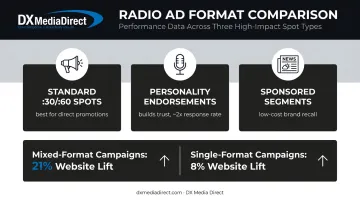
Standard :30 and :60 second spots work best for direct promotions: a weekend sales event, a clearance on last year's inventory, a lease special with a hard deadline. They're fully scripted and produced, giving you complete control over the message.
On-air personality endorsements carry a different kind of weight. When a trusted local host reads your offer in their own voice, it builds credibility a produced spot can't match on its own. Listeners already trust that voice from years of tuning in daily.
Sponsored news, weather, or traffic segments offer a lower-cost way to stay top-of-mind. You're not pitching a sale in these; you're building consistent brand association every time someone checks the forecast or their commute time.
Whichever format you choose, keep the message tight. One offer. One clear call-to-action: a specific deal, a deadline, a phone number or address. Trying to pack three messages into one :30 spot dilutes all of them.
Format combinations also compound results. An automotive attribution study covering 1.8 million commercials across 310 advertisers found that campaigns mixing spot lengths averaged 21% website lift, compared to just 8% for single-format campaigns, according to the LeadsRx and iHeartMedia automotive attribution study. Personality endorsements alone drove roughly double the response of non-endorsed spots.
Best Practices for a High-Performing Dealership Radio Campaign
A few habits separate campaigns that generate traffic from ones that just generate airtime:
- Keep each ad focused on one offer, not the whole lot at once
- Stay consistent: use the same phone number, URL, and sonic branding or jingle across every spot so recall builds over time
- Test before you scale. Run multiple creative and daypart combinations over a defined window, such as 90 days, before committing to a bigger budget
Skipping that testing phase is the most common mistake. Dealerships that scale spend before they know what's actually working end up guessing twice as expensively.
Why Partner with an Experienced Radio Advertising Agency
Self-service and programmatic radio-buying tools have a structural ceiling. They can't access the premium dayparts, remnant inventory, or negotiated rates that come from decades of direct relationships with station reps. That inventory simply isn't offered through a portal.
This is where experience compounds. DX Media Direct has spent 35+ years in direct-response advertising, running thousands of campaigns across TV, radio, and other channels. That track record creates advantages no portal can replicate:
- Pattern recognition to diagnose whether an underperforming campaign is a media mix or creative problem — before the budget gets scrapped
- Long-standing station rep relationships that unlock preferential dayparts and rates
- Structured testing frameworks built from thousands of executed campaigns
Rather than relying on scattered or inconclusive test data, the agency builds structured campaign tests into scalable playbooks, so decisions come from evidence rather than guesswork.
Dealerships exploring radio for the first time can put that same structured approach to work with a free, no-obligation consultation that maps out what a properly designed test looks like for their market.
Frequently Asked Questions
How much would it cost to advertise on radio?
Cost depends heavily on market size, daypart, and how many spots you run per week. Local dealership radio campaigns cost far less than TV or premium digital advertising for comparable reach.
Is radio a good way to advertise?
Yes. Radio still reaches the vast majority of adults each week. Its strong in-car listening share makes it particularly effective for local businesses like dealerships trying to reach active shoppers.
What is the best time of day to run car dealership radio ads?
Morning and evening drive-time dayparts tend to perform best, since that's when the largest share of in-car listening happens and shoppers are most receptive.
How many radio ads should a dealership run per week to see results?
Frequency matters more than a single spot ever will. Industry data suggests dealerships need a consistent, medium-to-heavy weekly volume, not sporadic spots, to generate a measurable traffic lift.
Can radio advertising really be tracked or measured?
Yes. Connected-car attribution studies and emerging geo-targeting technology now let advertisers link radio exposure directly to website visits and physical showroom traffic, closing radio's old measurement gap.
Is radio advertising better than digital ads for car dealerships?
Neither replaces the other. Radio delivers strong local reach and brand recall, which often makes digital campaigns perform better when the two run together.