Introduction
Everyone assumes radio is dying. Meanwhile, U.S. local radio revenue was forecast to hit $12.3 billion in 2025, according to a BIA forecast reported by Inside Radio. That's not a rounding error. That's an entire industry still moving real money.
Here's the pain point we hear constantly: business owners assume radio is outdated, or worse, impossible to measure against a Facebook ad dashboard. Neither is true, but the confusion is understandable given how much noise digital advertising makes.
To clear up that confusion, this article breaks down radio's formats and real costs, then shows the genuine benefits and how to build a campaign that performs. We'll draw on decades of hands-on media buying experience, the kind that comes from negotiating actual rates with actual station reps, not scrolling through a self-serve dashboard.
Key Takeaways
- Radio reaches 87% of U.S. adults weekly, per Nielsen/RAB data
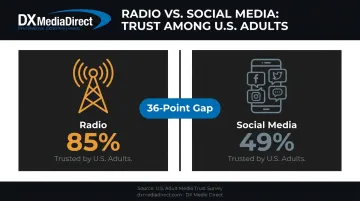
- Listeners trust radio more than social media, with surveys showing 85% vs. 49% trust ratings
- Ad formats range from live DJ reads to fully produced spots, jingles, and testimonials
- Costs shift dramatically by market size, daypart, and station popularity
- Relationship-based media buying often unlocks rates that self-service platforms can't touch
What Is Radio Advertising?
Radio advertising means purchasing airtime on AM/FM stations, or increasingly, on streaming and podcast audio platforms, to broadcast a paid commercial message. A standard spot commercial runs 15, 30, or 60 seconds. That's different from an infomercial, which stretches into long-form programming, sometimes 30 minutes or more, built around direct-response offers.
Industry terminology overlaps quite a bit, so here's how the terms break down:
- Radio spot: the standard term for a scheduled commercial unit
- Radio commercial: used interchangeably with "spot"
- Audio ad: the broader term, especially relevant for streaming and podcast inventory
- Broadcast advertising: an umbrella term covering radio and TV together
A Century of Staying Power
Radio advertising isn't new, and that's part of its credibility. The first paid radio commercial aired on August 28, 1922, on New York station WEAF. The advertiser, Queensboro Corporation, paid roughly $50 for about 10 minutes to promote Hawthorne Court Apartments, according to NPR's account of the broadcast.
More than a century later, the format has simply expanded. Today's "radio" buy can include traditional AM/FM slots alongside streaming audio and podcast inventory, all under the same strategic umbrella.
Types of Radio Ads
Not all radio ads sound the same, and they shouldn't. The format should match the goal.
| Format | Best For | Key Trait |
|---|---|---|
| Live read/DJ endorsement | Building trust fast | Host delivers message in their own voice |
| Produced straight-read spot | Clear offer communication | Scripted, announcer-voiced, no music |
| Jingle | Long-term brand recall | Musical hook tied to brand identity |
| Testimonial | Credibility | Real customer or client voice |
| Sponsorship | Ongoing brand association | Tied to recurring segments like traffic or weather |
| Character-driven/dialogue | Emotional engagement | Story-based, distinct character voices |
Live Reads Carry Personality Weight
When a trusted local host reads your message, listeners treat it differently than a produced ad. One documented utility-company campaign saw DJ endorsements generate 36 new customers per airing, 21% above the campaign's overall average. That's a single case, not a universal rule, but it illustrates why personality-driven ads earn premium placement.
Jingles Work, Sometimes
The "Have You Tried Wheaties?" jingle debuted in 1926 as one of the earliest commercial radio jingles, and it stuck around for decades. Music can act as a memory cue for advertising slogans, though research is mixed.
Not every jingle beats a well-placed piece of existing music. Pretesting matters more than assuming a catchy tune will do the work automatically.
Character-Driven Ads in Practice
Picture two neighbors arguing over whose gutter company did a better job, with the punchline landing on your brand. That's the format: a short scene, distinct voices, and a resolution that plants your name in the listener's head without sounding like a sales pitch.
Why Radio Advertising Works: Key Benefits
Massive Reach and High Trust
Radio isn't a niche channel. It reaches 87% of Americans age 18 and older every week, according to Nielsen Audience Insights data via RAB. That number climbs even higher among adults 50 and up.
Trust is where radio really separates itself. A recent Katz Radio Group survey found 85% of U.S. adults consider radio trustworthy, compared to just 49% for social media, a 36-point gap. That gap matters as consumers grow more skeptical of feeds and algorithms.
Cost-Effective, Precisely Targeted Media
Radio production doesn't require a camera crew, a shot list, or a video editor. A script, a voice talent, and a few hours in a booth can produce a broadcast-ready spot. That translates to:
- Lower upfront production costs than TV or video
- Faster creative turnaround for lean marketing teams
- Easier A/B testing of multiple scripts within the same budget
Format and daypart do further targeting work before you write a single word of copy:
- Country stations reach a different audience than news/talk stations
- Morning drive catches commuters; evening drive catches a different, often more relaxed listener
- Weekend sports programming delivers a highly specific demographic tuning in for one reason
Cross-Channel Lift and Lasting Recall
Radio's influence extends well beyond the dial. Research from the Radio Advertising Bureau's Radio Drives Search study, which analyzed more than 2,100 local radio ads across six categories, found an average 29% incremental lift in Google searches tied to radio flights. Pair a radio schedule with a live search campaign, and you're often measuring radio's impact whether you meant to or not.
That kind of downstream action fits a broader pattern: audio sticks in memory in a way scrolling text doesn't. Listeners in cars, at work, or doing chores absorb a message passively, then act on it later at a store, a search bar, or a phone call. That lag between exposure and action is exactly why attribution requires patience and the right tracking tools.
How Much Does Radio Advertising Cost?
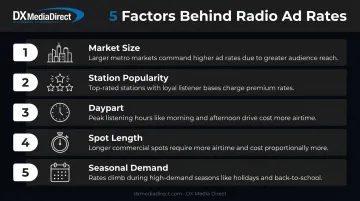
There's no single honest answer to "what does a 30-second spot cost?" Rates swing based on:
- Market size — a spot in a top-10 metro costs more than the same spot in a mid-size market
- Station popularity — a top-rated morning show commands a premium over a low-rated overnight slot
- Daypart — drive-time hours (roughly 6-10 a.m. and 3-7 p.m.) sell at higher rates than late-night inventory
- Spot length — 15-second spots cost less than 30s or 60s versions
- Seasonal demand — Q4 holiday inventory tightens up fast
In practice, spot rates can run from under $10 in small markets to several thousand dollars for prime drive-time slots in major metros.
Why Inventory Constraints Matter
Stations only have so many commercial minutes per hour. During peak seasons, popular dayparts sell out, and rate-card pricing becomes a starting point for negotiation rather than a fixed number.
This is where relationships change outcomes. At DX Media Direct, 35 years of buying volume and network relationships open access to inventory that never reaches the open market. That's the structural advantage self-service and programmatic platforms simply cannot replicate.
How to Launch a High-Performing Radio Campaign
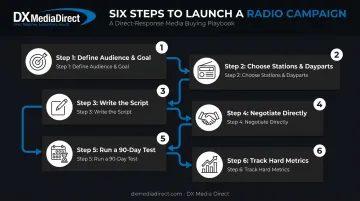
Step 1: Define Your Audience and Goal
Decide upfront whether you're chasing brand awareness or direct-response conversions. The two require different stations, different scripts, and different success metrics. A home improvement brand chasing calls needs a punchy, offer-driven script, while a legal firm building recognition needs steady frequency on trusted stations.
Step 2: Choose Stations and Dayparts Based on Data
Don't guess where your customer is listening. Use ratings data and audience research to match station format and daypart to your actual buyer profile. Nielsen Audio ratings show whether morning drive news-talk or afternoon adult contemporary reaches more of your target buyers.
Step 3: Write a Script That Does One Thing Well
Keep it simple:
- Lead with the hook or emotional angle
- State the offer clearly
- End with one specific call to action
- Match length to message depth (a 15-second spot can't carry a complicated offer)
Step 4: Negotiate Directly, Not Through a Portal
Insertion-order portals give you whatever inventory is left over. Direct negotiation with network and station reps, built on years of relationship and volume, is how you get preferential rates and better slots. DX Media Direct has spent 35 years building exactly those network relationships, which shows up directly in the rates and inventory clients receive.
Step 5: Run a Time-Boxed Test Before Scaling
A 90-day pilot gives you enough data to see real patterns without betting the full budget on early, inconclusive results. Use that window to build a repeatable playbook, not a guess.
Step 6: Track Hard Metrics, Not Vanity Numbers
Measure what actually ties to revenue:
- Phone call volume during and after the campaign
- Promo code redemptions
- Website and search traffic lift correlated with air dates
Vanity impressions don't pay bills. Calls, codes, and traffic spikes do.
Frequently Asked Questions
How much is a 30-second ad on radio?
Costs vary widely by market size, station audience, and daypart, with local spots typically far cheaper than national drive-time placements. Negotiated agency rates often beat published rate-card pricing by a wide margin.
What is an example of a radio advertisement?
A common example is a character-driven story ad, like two neighbors debating a service experience, with the brand name landing at the punchline. Testimonial spots using real customer voices are another frequent format.
What do you call radio advertising?
It's commonly called a "radio spot," "radio commercial," or "audio ad." Advertisers use these terms interchangeably across both traditional broadcast and streaming audio inventory.
Is radio advertising still effective in the digital age?
Yes. Radio maintains high weekly reach and stronger listener trust than social media, and it often amplifies digital and social campaigns rather than competing with them.
How do you measure the success of a radio ad campaign?
Track phone call volume, promo code redemptions, and spikes in website traffic or search interest that align with your on-air schedule. These metrics tie directly to revenue impact.
What's the difference between buying radio ads directly and through an agency?
Agencies with long-standing network relationships, such as DX Media Direct's three decades of direct-response media buying, often secure better rates and preferential inventory access that self-service or programmatic buying structurally cannot match. They also bring strategic guidance built from years of campaign data.