Introduction
Picture two options on your media plan: a quiet gym lobby screen with a captive audience, or a highway billboard seen by thousands of drivers an hour. Which one earns back its budget?
Most guides stop at definitions. They'll tell you what a billboard is, list a few mall poster examples, and call it a day. What they won't tell you is how to allocate dollars for actual revenue, not just impressions.
That allocation question starts with reach. Nearly 90% of US travelers noticed out-of-home advertising in the past month, according to OAAA's 2023 travel behavior study. That reach is real. So is the confusion about where to spend it.
This guide breaks down indoor versus outdoor advertising, the four core media categories, a direct-response framework called the 40-40-20 rule, and a practical way to build a mix that shows up in your profit column.
Key Takeaways
- Indoor advertising builds recall in high-dwell spaces like malls, gyms, and airports
- Outdoor advertising delivers mass reach and brand awareness across busy public spaces
- Advertising media breaks into four categories: broadcast, print, outdoor/OOH, and digital
- The 40-40-20 rule prioritizes audience and offer strength over creative polish
- Winning campaigns test small, track hard revenue data, then scale what works
What Is Indoor and Outdoor Advertising?
Indoor and outdoor advertising differ in one fundamental way: who's watching and for how long.
Indoor ads reach a captive, stationary audience inside a controlled environment. Outdoor ads reach a broad, moving audience navigating public spaces. That single difference shapes everything else, from creative strategy to cost to how you measure success.
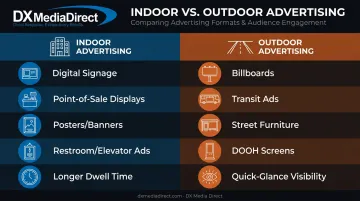
Indoor Advertising: Definition and Examples
Indoor advertising places ads inside enclosed, controlled venues, where visitors typically stay for extended periods. That longer dwell time gives audiences more time to notice, read, and remember a message.
A Nielsen study commissioned by Clear Channel Airports found that 56% of business frequent flyers recalled airport ads. Airport visits often run an hour or more, giving these placements extended exposure time.
Common indoor formats include:
- Digital signage in malls, gyms, and airport terminals
- Point-of-sale displays near checkout counters
- Posters and banners in restaurants, fitness centers, and shopping centers
- Restroom and elevator advertising in office buildings and venues
Outdoor Advertising: Definition and Examples
Outdoor, or out-of-home (OOH), advertising places ads in open public spaces designed for mass, quick-glance visibility. These placements need to communicate instantly since most viewers only get a few seconds of exposure.
Common outdoor formats include:
- Billboards (static bulletins, posters, and digital billboards)
- Transit ads on buses, subways, and taxis
- Street furniture like bus shelters and kiosks
- Digital out-of-home (DOOH) screens in high-traffic corridors
Indoor vs Outdoor Advertising: Key Differences
Choosing between indoor and outdoor advertising comes down to matching the format to your goal, budget, and message. Here's how the two stack up side by side:
| Factor | Indoor Advertising | Outdoor Advertising |
|---|---|---|
| Audience type | Niche, contextually relevant | Broad, high-volume |
| Attention span | Minutes (longer dwell time) | Seconds (quick glance) |
| Message style | Detailed, layered | Bold, instant |
| Weather exposure | None (climate-controlled) | Full exposure to sun, rain, pollution |
| Typical cost driver | Venue traffic and screen count | Location, size, and daily impressions |
Attention and engagement differ sharply between the two formats. Roadside OOH often gets just 1-2 seconds of viewer attention, per Lumen eye-tracking research shared by JCDecaux. Indoor environments change that dynamic entirely: someone waiting for a flight or finishing a workout has time to absorb a fuller message.
That attention gap carries a price tag: cost works differently for each format. Solomon Partners' 2023 Media Trends Report puts the broad OOH CPM at roughly $8.00, a channel-wide benchmark rather than a fixed rate per format. Outdoor placements in high-traffic corridors generally command higher premiums than a single indoor poster, simply because of scale and demand for the location.
Beyond cost, physical conditions set the two apart: weather and visibility matter far more for outdoor placements. Industry guidance recommends outdoor digital displays run at 4,000+ nits to stay visible in direct sunlight, plus weatherproof housing rated for dust and moisture. Indoor screens skip that requirement entirely.
Regardless of setting, measurability remains a shared weak spot: neither format guarantees direct sales attribution without help. That's why trackable calls-to-action (think unique URLs, dedicated phone numbers, or promo codes) matter more than the format itself.
Four Main Types of Advertising Media
Every advertising channel falls into one of four broad categories:
| Category | Definition |
|---|---|
| Broadcast | TV and radio, including AM/FM stations and cable networks |
| Newspaper and magazine placements | |
| Outdoor/OOH | Billboards, transit, street furniture, and place-based media |
| Digital | Connected media, including websites, apps, and DOOH (digital out-of-home) screens |
Indoor and outdoor advertising both fall under the OOH umbrella, but the lines are blurring fast. Digital out-of-home now accounts for roughly 29% of total OOH revenue, meaning more screens, both indoors and out, run dynamic, connected content instead of static posters.
Beyond OOH's digital shift, broadcast media, particularly direct-response TV (a specialty at DX Media Direct), often works as a complementary layer to indoor and outdoor campaigns.
A shopper who saw a billboard on the drive home might see a related ad that night on cable TV, complete with a trackable phone number or landing page. Same audience, reinforced message, measurable response.
The 40-40-20 Rule: A Direct-Response Lens for Indoor and Outdoor Campaigns
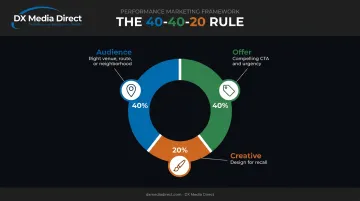
Long before programmatic dashboards existed, direct marketers followed a simple formula, commonly attributed to marketer Ed Mayer in the 1960s (though its exact origin isn't formally documented): 40% audience, 40% offer, 20% creative.
Applied to physical media placement, it looks like this:
- Audience (40%) — Choosing the right venue, route, or neighborhood matters more than how the ad looks. A billboard in the wrong ZIP code won't work no matter how sharp the design is.
- Offer (40%) — A compelling call-to-action, discount, sense of urgency, or simple response mechanism drives most conversions. This applies equally to a mall display and a highway bulletin.
- Creative (20%) — Design still matters for brand recall, but it shouldn't consume the lion's share of your budget or planning time at the expense of testing audience and offer combinations.
The practical difference shows up clearly between two environments:
| Environment | Offer Format |
|---|---|
| Mall display | Can include richer detail, since shoppers linger nearby |
| Highway billboard | Condensed to five words or fewer, visible from a moving car |
This rule supports a test-and-scale approach rather than a full-budget leap. It mirrors how agencies structure focused test periods, similar to a 90-day TV test, before rolling out a campaign at scale. You commit smaller dollars, measure actual response, and let performance data decide what gets more budget next quarter.
How to Choose the Right Indoor/Outdoor Mix for Measurable ROI
Start with the goal, not the format. Brand awareness favors outdoor and its broad reach, while conversion-focused campaigns favor indoor or trackable direct-response formats where audiences are already primed to act.
From there, follow a structured process:
- Test before you commit. Split a smaller budget across both formats first. Scale whichever mix performs, rather than betting the full spend upfront on an assumption.
- Build tracking in from day one. Add dedicated phone numbers, QR codes, or unique URLs to every placement, indoor and outdoor alike, so you're capturing hard performance data instead of guessing.
- Negotiate placements through relationships, not portals. Automated, self-serve booking rarely secures the best rates or premium inventory. DX Media Direct's 35 years of direct relationships with network and venue representatives often unlock better pricing than a programmatic dashboard ever will.
- Get a second set of eyes on your plan. A tailored media mix, weighted correctly across indoor, outdoor, and broadcast, beats a one-size-fits-all buy every time.
DX Media Direct offers a free, no-obligation consultation to map out this mix for your business, backed by 35 years of relationship-based buying power that self-serve platforms can't match.
Frequently Asked Questions
What are examples of indoor and outdoor advertising media?
Indoor examples include digital signage, point-of-sale displays, and mall posters. Outdoor examples include billboards, transit ads, and street furniture like bus shelters and kiosks.
What are the four main types of advertising media?
The four core categories are broadcast (TV and radio), print (newspaper and magazine), outdoor/OOH, and digital. Many modern campaigns blend digital capabilities into outdoor through DOOH screens.
What is the 40-40-20 rule in advertising?
It's a direct-response guideline: audience quality and offer strength each drive 40% of campaign success, while creative execution accounts for the remaining 20%. In short, targeting and offer matter more than ad polish.
Which is more cost-effective, indoor or outdoor advertising?
Outdoor offers stronger reach-per-dollar for mass-awareness campaigns, with broad OOH CPMs averaging around $8.00. Indoor costs vary widely by venue and screen count, so affordability depends on your specific placement and market.
Can indoor and outdoor advertising be combined in one campaign?
Yes. Combining both formats reinforces your message across different environments and attention spans. Adding trackable elements like promo codes or unique URLs strengthens ROI measurement across the entire mix.
How do you measure ROI on outdoor advertising campaigns?
Use unique promo codes, dedicated landing pages, and call-tracking numbers tied specifically to the outdoor placement. Pairing these with exposed-versus-control or sales-lift analysis gives a clearer picture of actual incremental impact.