Here's the short version: media planning is the strategy — who you're targeting, where you'll reach them, and when. Media buying is the execution — how you secure that placement and at what price.
For direct-response advertisers, this distinction isn't academic. It determines whether a campaign generates trackable revenue or just racks up impressions nobody can tie back to a sale. Nielsen's analysis of media plans found that 25% of channel investments were too high (overspending by a median of 32%), while 50% were too low (underinvesting by a median of 52%) — a gap that separates strategy from guesswork before a single dollar even hits the buy Nielsen.
Key Takeaways
- Media planning defines strategy: audience, channels, budget, and KPIs.
- Buying executes that strategy through negotiation and placement purchasing.
- Both functions form a continuous feedback loop, with buyer performance data reshaping future planning.
- The 5 M's — Mission, Money, Message, Media, Measurement — offer a repeatable framework for any media strategy.
- Programmatic wins on scale, but relationship-based buying secures rates and inventory access automated systems can't match.
What Is Media Planning?
Media planning is the research-driven phase that happens before an ad ever runs. It's where an agency or in-house team maps out audience, channels, timing, and budget against a specific business outcome, such as cost per lead or revenue per dollar spent.
Think of it as the blueprint. Skip it, and buying becomes a series of expensive guesses.
Audience Research and Segmentation
Planners build audience profiles using demographics, behavior patterns, and media consumption habits. Skipping this step wastes ad spend on the wrong audience before the campaign even launches.
A 2022 Nielsen study on campaign ROI drivers found that ad partners with strong on-target delivery averaged $2.60 in ROI for every $1 spent, compared to just $0.25 for partners with weaker audience delivery. That's a 10x gap driven almost entirely by whether the plan targeted the right people from the start.
Channel and Media Mix Selection
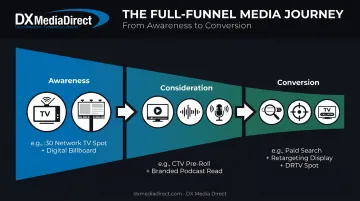
Planners decide where to invest based on where the audience actually spends time, not wherever a sales rep happens to be pushing inventory. This means mapping channels against the funnel:
- Awareness: broad-reach vehicles like linear TV or outdoor
- Consideration: CTV, streaming audio, podcasts
- Conversion: digital search, retargeting, direct-response TV
Nielsen's marketing mix modeling research found that a given channel performs well on both sales and brand outcomes in only 36% of cases. Judging a channel purely on immediate conversions misses how it contributes to brand outcomes.
Planning also shapes which creative formats fit each channel. A 30-second DRTV spot doesn't translate directly to a 15-second CTV pre-roll or a static outdoor board, so the plan sets the parameters creative teams work within.
Budget, Timelines, and KPIs
Planners allocate spend across the campaign's lifecycle, setting minimum thresholds for testing new channels and maximums to avoid overexposure before results come in. The goal is disciplined testing that earns bigger budgets once results prove out.
Every plan also needs measurable goals tied directly to the objective:
- Reach for awareness campaigns
- Cost per acquisition (CPA) for direct-response goals
- Brand lift for longer-horizon campaigns
What Is Media Buying?
Media buying is where the plan becomes reality. It's the execution phase: turning strategy into live, negotiated placements across the channels the plan identified.
Negotiating Rates and Choosing a Buying Method
Buyers work to lower cost-per-impression while pushing for value-adds: bonus spots, better dayparts, or upgraded placements at no extra cost. This is where relationships matter. A buyer who's worked with the same network reps for years negotiates differently than someone submitting an insertion order through a portal.
Not all buying looks the same, though. The method depends on the channel and the level of control needed:
| Method | How It Works | Best For |
|---|---|---|
| Direct/negotiated | One buyer, one seller, fixed price | Guaranteed inventory, premium placements |
| Programmatic (RTB) | Open, auction-based bidding | Scale, automated digital reach |
| Network buying | Upfront or scatter deals with TV networks | National linear TV commitments |
Monitoring, Optimizing, and Reconciling Campaigns
Once ads go live, buyers track pacing (is spend on schedule?), frequency (are the same people seeing it too often?), and viewability.
This isn't a set-it-and-forget-it process: they reallocate budget toward what's working, adjust bids, and swap creative based on in-flight performance. A show underperforming in week one might get cut by week two, with that budget shifted to a station that's converting.
After the campaign ends, buyers reconcile actual spend and delivery against the original plan. If a network underdelivered on promised impressions, they negotiate "make-goods": additional inventory that covers the shortfall.
Media Planning vs. Media Buying: Key Differences
Here's the foundational distinction: planning determines who, where, and why; buying determines how and at what cost.
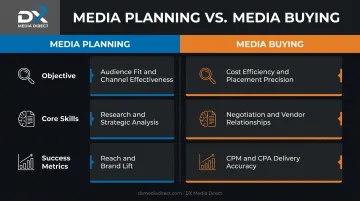
Beyond that core split, the two functions differ in what they optimize for and how success gets measured:
| Dimension | Media Planning | Media Buying |
|---|---|---|
| Objective | Audience fit, channel effectiveness | Cost efficiency, placement precision |
| Core skills | Research, strategic analysis | Negotiation, vendor relationships |
| Success metrics | Reach, brand lift, channel performance | CPM, CPA, delivery accuracy |
Neither function works in isolation. Buyer-side performance data should flow directly back into the next planning cycle:
- Which stations converted
- Which dayparts underdelivered
- Which creative fatigued fastest
That feedback loop is what separates a campaign that improves quarter over quarter from one that just repeats the same mistakes at a bigger budget.
The 5 M's of Media Strategy
The 5 M's, documented in Kotler and Keller's Marketing Management, give advertisers a practical checklist for building a strategy from the ground up:
- Mission: Define the campaign's core objective, whether that's building awareness, generating leads, or driving direct sales.
- Money: Determine how much budget exists and how it should be split across channels and timeframes.
- Message: What creative and copy will actually resonate with this specific audience?
- Media: Which channels (TV, digital, radio, outdoor) will carry that message most effectively?
- Measurement: Which KPIs will determine whether the campaign actually worked?
Skip any one of these, and the whole structure gets shaky. A campaign with a clear Mission but no Measurement plan is just spending money on faith. DX Media Direct treats all five as non-negotiable, pairing every 90-day TV test with hard revenue tracking.
Programmatic vs. Traditional Media Buying: Which Approach Fits Your Goals
Programmatic buying automates the transaction: real-time bidding platforms match ad inventory to audiences at scale, with minimal human negotiation. For brand-awareness campaigns chasing broad reach, that automation is genuinely useful.
But for direct-response advertisers, programmatic has structural limits:
- No relationship-based negotiation: automated exchanges price by auction, not by rapport
- Markups baked in: ANA's programmatic supply chain study found that 29% of every dollar entering a DSP went to transaction costs, with another 35% lost to media productivity issues like non-viewable impressions
- Limited premium TV access: the best inventory on major networks is often sold directly, not through open auction
Where relationship-based buying wins: decades of network relationships still matter here. DX Media Direct has spent 35 years buying direct-response TV inventory, building insider access to network reps that no self-serve platform can replicate.
That history translates into rates and placements programmatic systems can't reach. It also brings something automation still struggles with: knowing whether an underperforming campaign is a media mix problem or a creative problem.
Choosing an approach:
- Brand-agnostic scale: programmatic likely fits
- Measurable, revenue-tracked direct response: an experienced buying partner paired with a disciplined test campaign, run small before scaling budget, reduces risk while proving what works
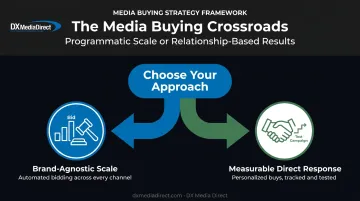
Neither approach is universally "better." The right choice depends on whether you're chasing impressions or profit.
Frequently Asked Questions
What is the difference between media planning and media buying?
Planning is the strategic phase: deciding what, why, and when to advertise. Buying is the execution phase: negotiating and purchasing the actual placements. Both must align for a campaign to succeed.
What are the 5 M's of media strategy?
Mission, Money, Message, Media, and Measurement. Together, they guide a campaign from setting objectives through tracking whether it delivered results.
Do media planners and buyers actually work together?
Yes. Planners set the roadmap, and buyers execute it, but ongoing collaboration matters most. Buyer performance data feeds back into planning, sharpening every future campaign.
What is the difference between media buying and media execution?
Media execution is the broader term. It covers planning and buying, plus the ongoing optimization, tagging, and reporting that keeps a campaign on track after launch.
Is programmatic advertising always better than traditional media buying?
No. Programmatic offers scale and automation, but traditional relationship-based buying can secure better direct-response TV rates and inventory access that automated platforms structurally cannot match.
How do I know if I need a media buying agency instead of handling it in-house?
If your team lacks deep network relationships or dedicated negotiation expertise, an experienced agency often delivers stronger ROI and lower costs than building that capability from scratch.