An SEO freelancer here, a social media manager there, a design contractor for the logo, an ad buyer for paid search. Each one optimizes their own piece of the puzzle, and somewhere in the gaps, your brand message drifts. Budget leaks. Nobody owns the whole picture.
This post answers a simple question: what does a full-service marketing agency actually do, and how is it different from stitching together specialists or doing it all yourself? We'll also clear up a common misconception — "full service" doesn't mean the same thing at every agency. Some are digital-first, built around SEO and social. Others, like full-service direct-response advertising agencies, are built around TV and other measurable media designed to drive revenue directly.
Key Takeaways
- One accountable team replaces five disconnected vendors
- A single agency ends coordination gaps and inconsistent messaging
- Full-service models range from digital-first shops to direct-response specialists
- In-house vs. agency costs depend on scope, not just headcount
- The right fit depends on your primary growth channel, not the label
What Is a Full-Service Marketing Agency?
A full-service marketing agency manages the entire marketing function for a business — strategy, creative development, execution across channels, and performance measurement — under one roof. Instead of hiring a freelancer for content, another for paid ads, and a third for design, you work with one team that connects all of it.
That doesn't mean shallow generalism. The "jack of all trades, master of none" critique gets thrown at full-service agencies a lot, but it misses how these agencies actually operate today. Most structure themselves with dedicated specialists inside each discipline, coordinated by a strategist or account lead who keeps everything pointed at the same business goal.
Core Marketing Disciplines Typically Included
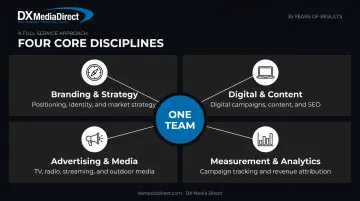
A genuine full-service agency typically covers:
- Branding & strategy — positioning, messaging, logo and identity work
- Digital & content — website design, SEO, social media management, content creation
- Advertising & media — paid search and social, and for some agencies, traditional media buying like TV and radio
- Measurement & analytics — performance tracking tied to business outcomes like conversions and revenue, not just impressions or likes
Why Coordination Matters
Coordination is the part most businesses underrate. It determines whether every discipline pulls in the same direction or works against itself.
When one strategist oversees every discipline, your website copy, your ad creative, and your content calendar all pull in the same direction. When five separate vendors each optimize for their own slice, they drift apart.
The SEO writer doesn't know what the ad team just tested. The designer hasn't seen the new messaging.
A 2022 WFA survey of 32 major advertisers found that 90% managed multiple agencies individually rather than through a coordinated structure, and 75% were only "somewhat satisfied" or less with how that setup worked. That's not a small-business stat, but it proves the same coordination problem exists even at the biggest advertiser level.
Full-Service vs. Specialized Agencies vs. In-House Teams
There's no universally "cheaper" option here. The right structure depends on scope, complexity, and how much coordination your marketing actually requires.
Where Each Model Fits
In-house teams require full salaries, benefits, software licenses, and management overhead for every specialist you hire. Building a comparable internal team from scratch means budgeting for a marketing manager, a content writer, a designer, and an analyst — each requiring its own hire and onboarding process.
Specialized/niche agencies work well for narrow, well-defined projects. A single website build or a one-off logo redesign doesn't need deep cross-channel coordination, so a specialist can handle it efficiently without the overhead of a broader team.
DIY marketing sounds cheapest until you count the hours. Constant Contact's 2024 survey of more than 1,300 small-business owners found that 56% had one hour or less per day to spend on marketing, 73% lacked confidence in their strategy, and 52% routinely pushed marketing aside for other priorities.
It's a time math problem, one that compounds every week you delay taking action.
Full-service agencies remove the coordination burden entirely. One team, one point of contact, no vendor chaos, no waiting on three different people to align before a campaign launches.
A Simple Decision Framework
| Situation | Best fit |
|---|---|
| Single, well-defined project | Specialized agency or freelancer |
| Very tight budget, high time availability | DIY (with realistic expectations) |
| Recurring campaigns across multiple channels | Full-service agency |
| Growth stage requiring consistent, scalable execution | Full-service agency |
Key Benefits of Partnering with a Full-Service Marketing Agency
The value goes beyond convenience. Coordinated execution is what actually produces results for your business.
Strategic focus. Instead of running disconnected tactics, a full-service agency builds a roadmap that connects every campaign back to a specific business goal — leads, sales, retention, whatever matters most to you.
Time savings. One point of contact replaces juggling multiple vendors, multiple invoices, and conflicting recommendations. You get one conversation instead of five.
Cost structure clarity. Building an equivalent internal department means multiple salaries, benefits, and tools. An agency retainer bundles that into one scope-based cost, though the right comparison depends entirely on what you're trying to accomplish, not headcount alone.
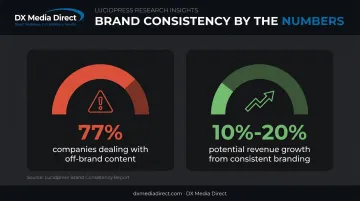
Consistent brand experience. Unified creative and messaging across every touchpoint isn't cosmetic. Lucidpress's 2021 State of Brand Consistency report found that 77% of companies dealt with off-brand content, and respondents estimated that consistent brand presentation could drive 10% to 20% revenue growth. That's a self-reported estimate, not an audited figure, but it lines up with what happens when your website, ads, and content all say the same thing.
Accountability through real metrics. A full-service team tracks traffic, conversions, and revenue impact, not vanity metrics like likes or impressions that don't connect to your bottom line. DX Media Direct, for instance, measures every campaign against hard numbers in the profit column, not follower counts.
Beyond Digital: Full-Service Doesn't Always Mean the Same Thing
Here's where a lot of buyers get tripped up. "Full service" isn't a certification. It's a description, and different agencies fill it very differently.
Full-service agencies generally fall into two categories:
- Digital-first agencies: focus on SEO, social media management, website builds, and paid search
- Direct-response advertising agencies: build campaigns designed to generate a measurable, trackable response, often combining TV and other traditional media with digital channels
DX Media Direct is an example of the second model. The agency has operated as a full-service direct-response shop for 35+ years, executing thousands of TV campaigns by combining strategy, creative, media buying, and performance optimization under one roof. That structure predates programmatic advertising entirely.
That longevity matters in a specific way: relationship-based media negotiation. Decades of working directly with network representatives, rather than buying inventory through automated insertion orders, give access to rates and remnant inventory that programmatic platforms structurally can't replicate.
It's the difference between a portal quoting you a rate and a person who's negotiated with that network for two decades.
The practical takeaway: when an agency says "full service," ask what that actually covers. Confirm which channels and disciplines they specialize in rather than assuming every full-service agency covers identical ground.
How to Choose the Right Full-Service Agency for Your Business
Not every full-service agency fits every business. Here's how to vet one properly.
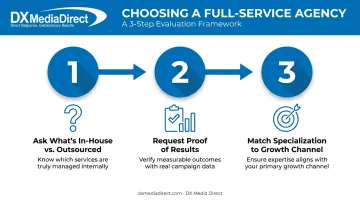
Ask what's handled in-house versus outsourced. Genuine full-service agencies keep most execution internal for tighter coordination. If most of the work gets subcontracted out, you're back to the vendor-chaos problem you were trying to avoid.
Request proof of results. Ask for case studies or campaign data showing measurable ROI, not just impressions or engagement counts. Revenue impact and conversion tracking tell you far more than reach ever will.
Match their specialization to your primary growth channel. A business relying on direct-response TV needs different expertise than an e-commerce brand focused on paid social. If TV drives your growth plan, look for an agency with deep media-buying relationships, not just a digital toolkit.
Once you've run through these checks, a free, no-obligation consultation offers a low-risk way to confirm fit before committing to a retainer. It lets you ask direct questions about scope, channel expertise, and reporting before any money changes hands.
Frequently Asked Questions
What does a full-service marketing agency do?
It manages branding, strategy, creative, digital channels, advertising, and measurement under one team. Instead of coordinating separate vendors, you get a single accountable partner overseeing the entire marketing function.
How is a full-service marketing agency different from hiring freelancers or specialized vendors?
Freelancers may cost less individually, but they create coordination gaps between projects. A full-service agency keeps messaging and strategy unified across every channel simultaneously.
How much does it cost to work with a full-service marketing agency?
Pricing depends on scope (branding, web work, ongoing media buying) rather than business size alone. Bundled retainers vary widely in what they actually include, so always confirm the deliverables.
Is a full-service marketing agency only for digital marketing?
No. "Full service" also applies to traditional and direct-response advertising models, including TV media buying, radio, and outdoor. Digital marketing is just one category within full-service work.
What size business benefits most from a full-service marketing agency?
Businesses with recurring, coordinated marketing needs across multiple channels benefit most. A single narrow project, like a one-time billboard placement, usually doesn't need full-service coordination.
What is a full-service direct-response advertising agency?
It's a full-service model focused specifically on campaigns designed to generate measurable, trackable revenue. Strategy, creative, and media buying, including TV, sit under one roof, as DX Media Direct demonstrates.