Introduction
Homeowners are spending big on renovations, and the market shows no signs of slowing. Annual spending on home improvements is projected to reach $518 billion by late 2026, according to Harvard's Joint Center for Housing Studies.
That demand exists. The problem for most remodeling companies isn't a lack of interested homeowners. Too many advertising channels exist, and few companies have a clear sense of which ones actually turn browsers into booked jobs.
Digital ads, social content, TV spots, streaming platforms, outdoor billboards. Each channel promises leads. Few remodelers know how to combine them into something that reliably fills a calendar.
This post breaks down the digital tactics, traditional and direct-response channels, creative concepts, and measurement framework that separate remodeling companies with full pipelines from those constantly chasing the next lead.
Key Takeaways
- Blend search, social, TV, and retargeting — never rely on one channel alone
- Before/after visuals and testimonials outperform generic service ads for big-ticket purchases
- Direct-response TV remains an underused lever for high-ticket home improvement brands
- Track booked jobs and revenue, not impressions or clicks, to know what's genuinely working
Why Home Remodeling Businesses Need a Deliberate Advertising Strategy
A kitchen remodel isn't an impulse buy. Homeowners are handing over tens of thousands of dollars and trusting a stranger inside their home for weeks. That kind of decision demands multiple touchpoints before someone picks up the phone.
The data backs this up: 80% of homeowners plan to research contractors before hiring, according to a 2025 Modernize Homeowner Insights Report covering more than 11,000 respondents. Nearly 41% compare at least two quotes, and a meaningful share compare four or more.
That research phase is exactly why single-channel advertising falls short. Every remodeler needs to cover three distinct jobs:
- Demand capture: reaching people actively searching right now ("kitchen remodel near me")
- Demand generation: reaching people who aren't searching yet but would be receptive to inspiration content
- Retargeting: staying visible to warm prospects who visited your site or requested a quote but haven't booked
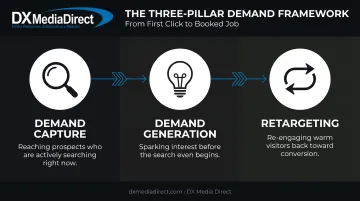
Companies with full calendars typically run all three simultaneously. Companies chasing leads month to month usually pick one channel and stop there. That gap usually comes down to structure, not budget.
Digital Advertising Ideas That Generate Remodeling Leads
Digital advertising covers the widest range of tactics, and remodelers often spread budget too thin across all of them. Here's what actually earns its place.
Search & Local Visibility
Your Google Business Profile is often the first thing a homeowner sees before your website. Keep it active with:
- Recent project photos uploaded weekly
- Authentic reviews requested after every completed job
- Accurate service areas and category tags for terms like "bathroom remodel near me"
Google Local Services Ads (LSAs) deserve serious consideration too. Unlike standard search ads, LSAs charge per verified lead rather than per click, and Google recommends budgeting for roughly 20 leads per week to get a meaningful read on performance.
Social & Visual Content
Homeowners browse Pinterest and Instagram the same way they'd flip through a design magazine, seeking inspiration rather than urgency. Meet them there with:
- Before/after sliders showing real transformations
- Project timelapse videos condensed into 30-60 seconds
- Client walkthrough videos filmed on-site, not overly produced
A "good/better/best" carousel (three price tiers for a similar project) helps price-conscious homeowners self-select before they ever call. This filters out mismatched leads before they hit your sales team.
Retargeting & Email
Most website visitors won't convert on their first visit. Retarget them with a specific offer, such as a "get your fixed quote in 48 hours" promise, across display and social placements.
Pair that with an email nurture sequence sharing project tips and before/after showcases. Renovation decisions can take months to finalize, so staying visible during that window keeps you top of mind when the homeowner is finally ready.
Traditional & Direct-Response Advertising: The Underused Advantage
Digital gets most of the attention, but it's not where remodeling decisions get made. Linear TV remains the dominant influencer for big-ticket home improvement purchases. In fact, 93% of homeowners who researched contractors online say TV ads influenced their selection, according to TVB's 2025 Home Improvement Purchase Funnel Study.
That's a striking number for a channel most remodelers write off as "too expensive" or "not trackable."
Why Direct-Response TV Changes the Equation
Traditional brand TV buys are hard to measure. Direct-response TV is different: every spot is built to drive a specific action, and every call or click can be traced back to the exact spot, network, and daypart that generated it.
This is where the gap between programmatic self-service platforms and experienced media buyers really shows. Most remodeling companies rely on automated platforms that book whatever inventory is available at whatever rate the system generates. Those platforms structurally cannot access preferential pricing built on decades of network relationships.
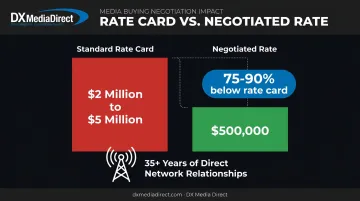
DX Media Direct has spent 35+ years negotiating directly with network representatives rather than booking through insertion-order portals. That relationship-based approach can secure remnant inventory (unsold ad slots) at 75% to 90% below rate card pricing.
A $500,000 test budget, bought this way, can deliver the equivalent reach of a $2 million to $5 million campaign at standard rates.
A few tactics worth layering in:
- Storm and seasonal alignment: Pairing exterior remodeling or restoration ads with local weather coverage keeps your brand top-of-mind exactly when homeowners are thinking about roofs and siding
- Streaming and CTV placement: Running spots on home-and-design content within Roku, Hulu, or HGTV's streaming apps reaches renovation-minded homeowners with fully trackable impressions
- Structured 90-day testing: Rather than guessing based on a few weeks of inconclusive data, a defined test window gives you a clear read on response before committing to a larger spend
Creative Ad Concepts That Convert Homeowners
The channel matters, but the creative decides whether homeowners respond. A few formats consistently outperform generic "we do remodeling" ads.
Before/after visual proof is the single most persuasive format in this category. Standardize your lighting and camera angles across shoots, and label each photo clearly (room, project scope, timeframe) so the transformation reads as credible, not staged.
Fast-turnaround offers reduce hesitation. Phrases like "room-in-a-week" or "48-hour fixed quote" give homeowners a concrete reason to act now instead of filing your ad away for "someday."
Trust and guarantee-based hooks flip common fears into selling points:
- Punctuality guarantees address the "contractor never showed up" fear
- Zero-mess demo proof (photos or video of covered floors, sealed doorways) counters worry about disruption
- Warranty callouts reduce anxiety about long-term quality
Guarantees defuse fear, but emotional connection seals the decision. Emotional, family-focused storytelling performs especially well on TV and video, building brand recall that outlasts purely feature-driven messaging. That recall matters for a purchase homeowners spend months deciding on.
Financing and value-add messaging removes cost anxiety. Show your "good/better/best" pricing tiers upfront, or highlight energy-savings estimates for window and insulation projects.
Finally, tie campaigns to real calendar events — a "guest-ready bathroom before the holidays" push creates urgency that feels natural instead of manufactured.
Building the Right Media Mix and Measuring What Actually Works
The strongest remodeling campaigns don't bet on one tactic. They pair demand-capture channels (search, LSAs) with demand-generation channels (social, TV) and layer retargeting on top to catch anyone who didn't convert the first time.
When a campaign underperforms, the hardest question to answer honestly is why. Is it the media mix (wrong channels, dayparts, or audience) or the creative (right channel, but a message that isn't landing)?
Diagnosing that distinction correctly takes pattern recognition across many campaigns. Pull a channel too early because the creative was weak, and you've cut a channel that might have worked with better messaging. Keep spending on a weak channel because you assume the creative is the problem, and you've wasted budget that should've been reallocated.
That diagnosis is only as good as the metrics behind it. Measurement should center on hard business outcomes, not vanity metrics:
| Metric Type | Examples |
|---|---|
| Vanity metrics (skip) | Impressions, reach, likes |
| Business outcomes (track) | Booked estimates, show-up rates, closed jobs |
If you're unsure whether your current mix is underperforming due to channel selection or creative fatigue, that ambiguity is worth resolving before you pull spend or double down on the wrong lever.
A free, no-obligation consultation with an experienced direct-response partner like DX Media Direct can help evaluate what's actually happening in your campaign data.

Frequently Asked Questions
What is the best advertising strategy for a home remodeling business?
The strongest strategies combine local search and SEO, social proof content like before/after visuals, and direct-response channels such as TV or radio. Relying on a single tactic leaves gaps in the homeowner's research journey.
Is TV advertising still effective for home improvement companies?
Yes. TV remains a top influencer for high-ticket B2C purchases, and direct-response methods let you track calls and leads back to specific spots and networks to prove ROI.
How much should a remodeling business budget for advertising?
Budgets vary widely by market and project size. Start with a smaller structured test, such as a 90-day trial, before scaling spend based on real response data.
Which social media platform works best for remodeling ads?
Meta and Instagram excel at visual before-and-after content, while Pinterest and YouTube support inspiration browsing and longer-form project storytelling.
How do I measure ROI on my remodeling advertising campaigns?
Track booked estimates, show-up rates, and closed jobs rather than clicks or impressions. These hard numbers show whether a campaign is actually generating revenue.
Should I use TV or digital ads to generate remodeling leads?
Both can work together. Digital captures homeowners actively searching, while TV and radio build broader awareness and trust with affluent homeowners over time.