Introduction
Marketers spend millions chasing a 30-second spot during the big game. Meanwhile, the same fans tune into sports radio and audio programming for hours every day, and far fewer advertisers show up there.
That gap is a mistake. Sports radio listeners aren't casual viewers who wander in during halftime. They're the fans who track offseason trades, argue with hosts on air, and build entire routines around drive-time shows.
Many marketers still treat radio like a legacy format losing ground to streaming and social media. Industry research says otherwise: Edison Research's Infinite Dial studies have tracked steady year-over-year growth in podcast listening and sports audio consumption, not decline.
This article breaks down what sports radio advertising actually is, why the format works, what formats and price points to expect, and how to buy it strategically.
Key Takeaways
- Sports radio listeners skew younger and trust host-endorsed ads more than TV
- Live host reads and sponsorships outperform recorded spots on trust and recall
- Costs vary by market size, daypart, and format, with no fixed national rate
- A scoped test campaign beats a full rollout for entering the format.
What Is Sports Radio Advertising?
Sports radio advertising means placing ads or sponsorships within talk radio, play-by-play broadcasts, and audio programming built around sports. This now spans AM/FM, streaming simulcasts, and podcasts, a mix the industry increasingly calls "sports audio."
Major national players advertisers can access include:
- ESPN Radio, with more than 400 full-time affiliates and over 9,000 hours of talk and event programming annually
- Fox Sports Radio, running 24/7 live programming across roughly 380 stations plus iHeartRadio
- Westwood One Sports, a rebranded network anchored by talk programming like The Jim Rome Show
- TUDN Radio, the national Spanish-language sports network for Hispanic markets
- Local team-affiliated broadcasts and regional sports stations
The Audience Behind the Dial
Picking the right network is only half the job; knowing who's actually tuning in matters just as much. Sports radio's audience profile is distinctive. The format skews heavily male, and listeners over-index for college education and higher household income.
One of the more useful comparisons for media planners is age. According to Nielsen's Year in Sports Media report, sports radio's median listener age was 44, compared to 48 for cable sports TV and 49 for broadcast sports TV. That's a meaningfully younger audience than the sports TV buy most brands default to.
Why Sports Radio Advertising Works: The Data Behind the Format
Casual listeners don't build their day around a talk show. Sports radio's core audience does. Roughly 84% of Americans identify as sports fans, and the format's regular listeners rank among the most committed within that group.
That commitment shows up in listening habits, not just self-reported enthusiasm. Nine in ten listeners consume both play-by-play and sports-talk content in a given week, and 40% of superfans say they prefer sports talk over watching the live games themselves.
Trust and Brand Affinity
This is where sports radio separates itself from most other ad formats.
According to Audacy's Sports Fandom & Advertiser Impact Study, 60% of weekly sports-talk listeners said local sports-talk ads felt more relevant and trustworthy than TV ads. Even more striking, 61% said they viewed a company more positively after that company partnered with a sports-talk host.
That trust translates into behavior. The same research found sports-radio listeners were:
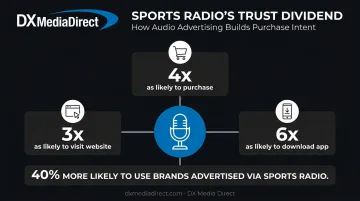
- 4x as likely to purchase from an advertiser
- 3x as likely to visit an advertiser's website
- 6x as likely to download an advertiser's app
compared to audiences reached through other sports channels. Fans were also 40% more likely to use brands advertised through sports radio than brands promoted elsewhere.
The Host-Listener Bond
Why does this happen? Part of it is habit. Listeners spend the majority of their tune-in time with a favorite station or host, which builds a familiarity that a rotating cast of TV commercials simply can't replicate.
Local sports talk reinforces that bond further: 80% of listeners said it delivers the most honest team coverage, and 90% said its unique content makes them feel personally connected to the show. When a trusted host reads your ad live, some of that trust transfers to your brand.
A practical note for skeptics: publicly available store-lift case studies specific to sports radio sponsorships are hard to find. But agencies running multi-channel direct-response campaigns see this trust dividend play out consistently. DX Media Direct, for instance, tracks radio buys station by station and daypart by daypart, cutting underperformers early and reinvesting in whatever channel is actually converting.
Types of Sports Radio Advertising Formats
Not all sports radio buys look the same. Choosing the right format matters as much as choosing the right station.
Spot and Sponsorship Formats
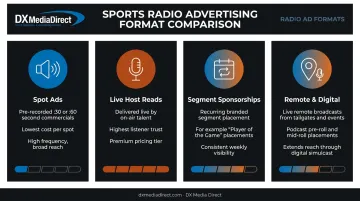
Traditional :30 and :60 commercials run during breaks. This is the baseline format, the equivalent of a standard TV commercial, and it's typically the most affordable entry point into the medium.
Live host reads work differently: instead of a pre-produced ad, the host reads your message live, in their own voice, often with personal commentary added. This format consistently outperforms recorded spots on trust because listeners hear it from someone they already believe.
Segment and franchise sponsorships add another layer, tying premium, high-visibility placements to a recurring feature:
- "Player of the game" sponsorships
- Traffic and score updates
- Injury report segments
- Drive-time feature sponsorships
Because these segments repeat daily or weekly, they build repetition without feeling like a traditional ad break.
Extended Reach: Remote and Digital Formats
Some stations broadcast live from tailgates, stadiums, or brand events. This format builds a deeper local community connection than any studio-based ad can achieve, though it typically requires more coordination and budget.
Digital formats extend that reach even further. As sports audio expands beyond AM/FM, so has ad inventory. ESPN and Audacy both now sell live-player audio spots and podcast pre-roll or mid-roll placements, letting brands extend a radio buy into on-demand listening. This mix of on-air and digital formats gives DX Media Direct's clients multiple ways to structure a sports radio buy.
How Much Does Sports Radio Advertising Cost?
There's no single answer here, and any source claiming a fixed national rate is oversimplifying. Costs vary based on:
- Daypart – Morning and afternoon drive command premium pricing because that's when the largest, most engaged audiences tune in
- Market size – Major markets like New York or Los Angeles cost significantly more than mid-size or small markets
- Buy type – National network buys and local station buys are priced and negotiated differently
- Format – Live-read endorsements and exclusive sponsorships carry a premium over standard recorded spots, because you're renting a host's credibility, not just airtime
Why Live Reads Cost More
A recorded spot competes for attention against other ads in the same break. A live read is delivered by someone the audience already trusts, and stations price that trust accordingly.
Getting Real Numbers
Sports-radio rate cards vary so widely by station and market that published numbers rarely hold up. The only reliable way to get an accurate cost range is to request proposals directly from stations or networks, broken out by daypart, unit length, and sponsorship type.
This is where relationship-based buying makes a real difference. Programmatic and self-serve audio platforms price inventory algorithmically, leaving no room for negotiation.
Agencies with long-standing network representative relationships operate differently. DX Media Direct, for example, draws on 35 years of media buying experience to access preferential rates and remnant inventory that automated platforms structurally can't reach, sometimes at 75% to 90% below rate card pricing.
How to Buy Sports Radio Advertising for Maximum ROI
Buying sports radio well starts before you ever call a station.
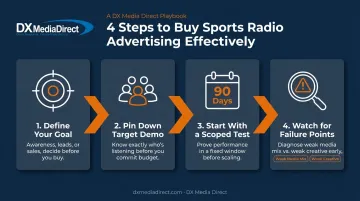
Define your goal first: are you building brand awareness, or driving immediate calls and clicks? The answer determines which stations, dayparts, and formats make sense.
Pin down your target demo: local team affiliation matters, since a station carrying a team's game broadcasts, for example, skews its audience toward that team's fanbase.
Start with a scoped test: a 90-day run across a handful of stations and dayparts builds a real, data-backed playbook before you commit to a full rollout.
Watch for two failure points: underperformance usually traces back to one of two problems:
- Weak media mix (wrong stations or dayparts)
- Weak creative (the message itself isn't landing)
Confusing the two leads to wasted budget.
A full-service partner like DX Media Direct can help separate those two variables instead of guessing. That diagnostic step is exactly where self-managed programmatic buys tend to fall short. There's no one reviewing whether the problem is the placement or the pitch.
Measuring ROI and Best Practices
Direct-response principles apply to sports radio just as much as they do to TV.
Attribution: Build it directly into the creative itself using:
- Unique promo codes per station or daypart
- Vanity URLs tied to specific placements
- Dedicated landing pages for each campaign flight
Without these, you'll never know which station actually drove results.
Knowing which station drove results is only half the equation. Digital and offline lift matter too: web traffic and branded search volume capture only part of the response, while foot traffic and in-store sales fill in the rest.
Location analytics tools like Placer.ai now let advertisers connect sports radio sponsorships to real-world store visits.
First-cycle learning matters most: early data should refine your station list, dayparts, and creative, not serve as a final verdict. Most agencies can tell within two weeks whether a station is generating viable results, but the full picture takes longer to emerge.
Frequently Asked Questions
How much does sports radio advertising cost?
Costs depend on market size, daypart, and ad format, so there's no single rate. Live-read sponsorships and exclusive segments cost more than standard recorded spots because they carry host credibility.
What is the difference between sports radio and sports talk radio advertising?
Sports radio is the umbrella term, covering play-by-play broadcasts, sports news, and talk programming. Sports talk radio specifically refers to the debate, analysis, and interview-style shows between games.
Is sports radio advertising still effective with podcasts and streaming on the rise?
Yes. Sports content's share of podcast listening grew 71% over five years, according to Audacy's analysis of Edison Research data, showing the format has expanded rather than declined.
What demographic does sports radio advertising reach?
The audience skews male, college-educated, and higher-income. It's also younger on average than sports TV viewers, with a median age of 44 versus 48 to 49 for TV sports audiences.
How do I choose the right sports radio station for my brand?
Match the station's format and local team affiliation to your target audience, then check daypart ratings and the host's influence with listeners. A station with a smaller but fiercely loyal audience can outperform a larger, less engaged one.
What's the difference between a spot ad and a sponsorship on sports radio?
A spot ad is a recorded commercial played during a break, priced and treated like standard airtime. A sponsorship is a host-endorsed or segment-integrated placement that carries higher trust with listeners, and typically a higher price to match.