Introduction
Every advertiser eventually hits the same fork in the road: run ads locally, go national, or try both. There's no universal right answer, and that's exactly the problem.
Many businesses choose based on sticker price alone. A $500 local spot looks cheaper than a $50,000 national buy, so local wins by default. But that comparison ignores cost-per-impression, audience fit, and what the campaign is actually trying to achieve.
Audience reach matters just as much as price. 64% of Americans still say they at least sometimes get news from local TV stations, according to Pew Research's 2024 survey on local news habits, though that's down from 70% in 2018. Meanwhile, national inventory remains the standard for mass-reach brand campaigns.
This guide breaks down what local and national advertising actually mean, where the real cost differences hide, and how to decide which fits your business. We'll also explain why the media buyer behind the campaign often matters more than the local-versus-national label itself.
Key Takeaways
- Local ads build community trust and target specific markets, but often carry a higher CPM than expected
- National campaigns deliver mass reach and brand credibility, but require bigger budgets and tighter inventory competition
- CPM, not total spend, is the only fair way to compare local and national buys
- Your growth stage, product type, and campaign goal should drive the decision, not habit
- A structured test-then-scale approach, guided by experienced media buyers, typically outperforms picking one format outright
Local vs. National Advertising: What They Actually Mean
What Is Local Advertising?
Local advertising places your ad within a specific Designated Market Area, or DMA. Nielsen defines 210 non-overlapping DMAs across the U.S., each an exclusive group of counties where a set of local stations dominates viewing.
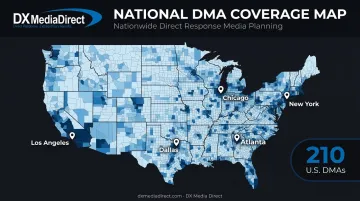
That's the actual boundary of "local," and it doesn't always match a city or county line the way you'd expect.
Local spots typically run alongside affiliate programming or local news blocks. Common characteristics include:
- Pricing set by local CPM, which swings widely based on market size and household income
- Availability that varies station-by-station, since there's no single national rate card
- Creative that often leans toward :30 units, though this isn't a universal rule across every market
What Is National Advertising?
National advertising distributes your ad across major networks, ABC, NBC, CBS, ESPN, and similar, reaching viewers coast to coast in a single buy. One placement, one creative, nationwide delivery.
National inventory tends to offer more creative flexibility, running :15, :30, and :60-second spots depending on the network and daypart. It also generates richer performance data simply because the sample size is bigger.
When NBC's Sunday Night Football commands over $1 million for a single 30-second spot in the 2024–25 season, you're paying for scale, not just airtime.
The Real Differences: Cost, Audience, Creative & Trust
Audience & Reach
National campaigns reach broad, diverse demographics in one placement. A soft drink brand running during a primetime NFL broadcast hits millions of households across every state in a single airing.
Local campaigns concentrate that same energy within a defined community. That's powerful if your business only serves that community, such as a regional HVAC company, and wasted reach if it doesn't.
Cost & CPM
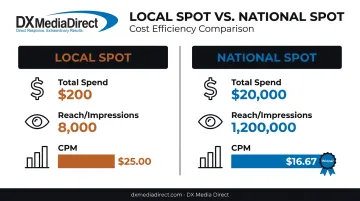
Here's where most advertisers get burned. A local spot might cost $200. A national spot might cost $20,000. On paper, local looks like the deal. But total spend and cost-per-impression are two different numbers entirely.
Consider a simplified example:
| Buy Type | Total Spend | Reach (Impressions) | CPM |
|---|---|---|---|
| Local Spot | $200 | 8,000 | $25.00 |
| National Spot | $20,000 | 1,200,000 | $16.67 |
In this scenario, the "cheaper" local spot actually costs more per thousand impressions. That's not always true; local CPMs vary by market and daypart, sometimes dropping well below national rates. But the point stands: sticker price tells you almost nothing until you divide it by reach.
Creative Messaging
National creative typically leans on broad brand storytelling with website or app-based calls to action. Local creative works differently, often featuring community faces, physical location shots, and localized offers like "visit our Main Street location this weekend."
Trust & Credibility
Local broadcast news consistently ranks among the most trusted media formats. 57% of viewers place local news among their three most trusted outlets, according to Nielsen's research on local media trust. That's a statement about the surrounding news environment, not proof that every local ad automatically earns that same trust, but running your spot inside a trusted context doesn't hurt.
Trust isn't the only local complication worth flagging. National campaigns aggregate into one clean report, while local campaigns don't work that way at all. With 210 separate DMAs in play, evaluating performance means stitching together market-by-market data, often across different time zones and viewing patterns.
This isn't a small hurdle. 38% of buyers cite measurement complexity as their leading activation challenge, per the IAB's 2025 Digital Video Ad Spend report. Multiply that complexity across a dozen markets, and you need real infrastructure, not a spreadsheet, to read results accurately.
Are There Fees for Local vs. National Advertising?
Both local and national TV involve layered costs. There's no single, published fee schedule, because pricing gets negotiated station-by-station and network-by-network.
Three cost layers to budget for:
- Production — creating the actual commercial, which can be reused across formats
- Media/airtime buy — the negotiated cost of the actual placement
- Agency or placement fees — compensation for whoever is securing and managing the buy
Here's where the format matters less than the method. Automated, self-serve programmatic platforms often stack ad-tech markups, data fees, and DSP charges on top of your media cost. Those fees aren't always visible upfront.
Relationship-based negotiation works differently. When a buyer works directly with network representatives instead of clicking through a portal, they can often secure net rates that simply aren't available through automated channels.
DX Media Direct has built its model around this approach for 35 years, negotiating directly rather than routing spend through a self-serve dashboard.
One more practical difference: national buys often carry higher minimum spend thresholds, while local stations frequently offer more flexible entry points. That flexibility matters if you want to test an offer before committing serious budget to it.
Which Strategy Is Right for Your Business?
There's no formula that works for every business, but a few factors consistently point the decision one way or the other.
Start with your goal. Launching a nationwide product or building broad brand awareness? National fits. Driving foot traffic to a storefront or building trust in one community? Local fits better.
Consider your budget and growth stage. Smaller or regional businesses often test locally first, validating their offer and creative before scaling into a national buy with real performance data behind them.
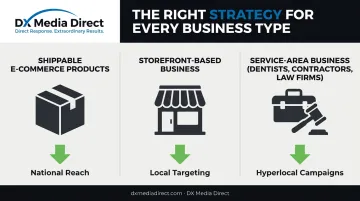
Match the strategy to what you're selling:
- Shippable, nationwide e-commerce products tend to benefit more from national reach
- Storefront-based businesses usually see stronger ROI from local targeting
- Service-area businesses like dentists, contractors, or law firms perform best when campaigns stay hyperlocal
Look at your competitive landscape too. If competitors already dominate national inventory in your category, a focused local strategy can reduce the noise you're competing against and stretch your budget further.
Many advertisers don't pick one at all. A hybrid approach, national campaigns for brand credibility paired with local spot buys or sponsorships for community trust, is common and often the most effective route.
If you're unsure where to start, run a structured test. Most industry test windows run around 90 days, giving you enough dayparts and networks to validate creative and offer performance before scaling. The difference between a test that burns budget and one that produces a clear, scalable playbook usually comes down to how the test is designed, not how long it runs.
Why Expert Media Buying Matters More Than the Local vs. National Debate
Here's the uncomfortable truth: local versus national is rarely the variable that determines success. Execution is.
Whoever buys your media needs to negotiate favorable rates, select the right dayparts and networks for your audience, and match your creative to the placement. Get any one of those wrong, and the format you chose won't save the campaign.
This is where 35 years of pattern recognition changes outcomes. DX Media Direct has spent decades building relationships with network representatives, the kind of relationships that secure rates and inventory access no self-serve programmatic platform can structurally replicate.
A dashboard can automate a buy. It can't pick up the phone and negotiate.
When campaigns underperform, the cause usually falls into one of two buckets:
- The media mix is wrong for the audience or offer
- The creative doesn't match the placement or campaign goal
Most often, both problems compound at once, making the true cause harder to isolate.
Sorting out which one is actually the problem is hard to do alone. That's the reasoning behind a free, no-obligation consultation, a chance to diagnose what's actually holding a campaign back before spending another dollar guessing.
Frequently Asked Questions
What is the difference between local and national advertising?
Local advertising targets a specific geographic market, usually a DMA, with community-focused messaging. National advertising reaches audiences across the entire country in a single buy with broader brand messaging.
Are there fees for national and local advertising?
Both involve production and media buy costs. Programmatic platforms often add ad-tech markups on top, while relationship-based agency buying can frequently avoid those extra charges through direct network negotiation.
Is local TV advertising cheaper than national TV advertising?
Local ads have lower total spend, but they often carry a higher CPM since they reach fewer people per dollar. Cost-effectiveness depends entirely on how you measure it.
Can a business run local and national advertising campaigns at the same time?
Yes. A hybrid approach is common and particularly effective, combining national reach for brand awareness with local placements for community-level trust and foot traffic.
How long should a local TV test run before scaling to a national campaign?
Most structured tests run around 90 days, which typically provides enough data across dayparts and networks to make a confident scaling decision.
Which is better for direct-response advertising: local or national TV?
It depends on your offer and fulfillment capacity more than the format itself. Expert media buying and disciplined testing usually matter more to ROI than whether you go local or national.